Wednesday, May 30, 2007

136 Points of Reference by Jonathan Ellery


I remember seeing Lee Friedlander at a lecture showing his work that was eventually published in his book Nudes. During the Q and A, someone asked him “What are your influences?” He paused and then said, “Well…yesterday I had a great bowl of bean soup.”

This, of course, wasn’t an answer we were expecting. This was a room of photographers. We wanted a “photography” answer. We wanted a tidbit of wisdom from a great artist.

Bean soup. He said bean soup, and that made more sense to me than if he rattled off a list of names known or unknown. After all, what were we going to think about if he had answered, “Oh…let’s see, Atget, Brassai, blah blah blah.”? Of course, influence comes from many directions and often from unexpected places.

The book 136 Points of Reference by the graphic designer Jonathan Ellery and his design studio Browns, examines influence through 136 objects from various collections.

These “points of reference” range from books, to a license plate and from manhole covers, to a photo of Bruce Gilden (not a photo by Bruce Gilden but a photo of Bruce Gilden). This book shows that Ellery has great design taste and finds fine examples in the most unexpected places. By featuring them inside a book and outside of the real world, he holds these objects up for close inspection and reveals both their beauty and hidden poetry.

This book works like opening a time capsule and examining the contents. Through these objects we may find a sense of who the collector was, and what material was an important part of their life.

A few sections of the book are given over to other artists who name a few of their own reference points. Martin Parr includes John Hinde Studios postcards, Evidence by Mike Mandell and Larry Sultan, the work of Tony-Ray Jones, and ephemera from a miner’s strike that includes a decorative plate. The great designer Alan Fletcher shares 5 of his own creations and constructions along with their back stories.

As you know, I love books that reproduce objects and this book satisfies in that sense. But the one draw back is, from knowing and seeing the collections of several designers in my life, they all seem to include the same kind of stuff. A drink coaster, an oddly beautiful luggage tag, postcards, books, street signage, advertisements, business cards, etc. A friend of mine compulsively photographs the designs on the labels of 45 rpm records, collects beer labels, and has an apartment full of examples of product packaging. All of those things have informed and educated him as a designer. Even Andy Warhol’s time capsules contained similar material and their references can be seen in his work.

If you think about the fact that the entire world is full of this ephemera and different human sensibilities, there could be several billion books of this sort created for every person on the planet. Maybe they wouldn’t be a nicely designed and presented as this book, but I know I’d like to take a long look at them.


As much as I enjoy this book, it is no revelation towards anything but a designer’s look at design. What we may need to do is ban designers from creating anymore of these books and only allow non-designers to do this sort of compiling.

I will bring up Martin Parr’s name one more time to mention one aspect of his collecting that intrigues me. Alongside his collections of what you might expect, postcards, Saddam Hussein watches, and the like, he diverges from “design coolness” and embraces poor examples in equal measure. His collections of Spice Girl ephemera and tacky wallpaper actually contribute to a more complete portrait of Parr, the world and what he draws from as reference than most designers might risk revealing.

By the way, someone should ask Jonathan Ellery what his 92nd Point of Reference is. His book jumps from 91 to 93. Perhaps a missing page could also be a considered a Point of Reference.


Or was it going to be a Spice Girl crisps wrapper?


This title is very expensive through Amazon so I am not providing a link.

Book Available Here (Evidence)

Book Available Here (Boring Postcards)

Book Available Here (Boring Postcards USA)

Book Available Here (Bliss)

Tuesday, May 29, 2007

Kratochvil, Pellegrin, Uimonen and the new photojournalism

In contemporary photojournalism there are a few practitioners who are testing the boundaries of the forms that traditional journalistic images have adopted. These are photographers who now embrace blur, rough impressionistic description and what I have referred to before as visual gymnastics into their images. This is perhaps an attempt to slap the viewer into paying attention. The combination of these characteristics has created what amounts to be what I see as a new formalism among some contemporary photojournalism.

When Gilles Peress traveled to Iran in 1980 to see the reality of the Islamic revolution first hand, he brought back a new form of personal journalism. His choice of the implied road trip narrative to covering current news events paved the way for younger journalists seek out new ways of describing the events they were covering. It has created a form of impressionistic photo story where facts are described in ways that favor the general mood and emotion of the situation. It is essentially a subjective journalism infused with the personal reactions of the photographer.

What creates this sense of personal reaction is obviously directly linked to how photographers adopt and hone their individual instincts in making pictures. While honing these instincts the photographer (all photographers) often learn by example. For instance, in photojournalism, the adoption of the 28mm wide angle lens and the in-close, low to the ground vantage point was an attempt to bring the viewer into the realm of the action (and vicarious danger) and thus became a standard descriptive tool. Many photographers used this new language, applying it to their subjects in an attempt to fit in with the newly perceived dynamism that was being seen in the work of others.


It is one thing to adopt and force a form onto your subject and yet another to react using your instincts to find the form of the picture. This is what Garry Winogrand was so adamant in attempting to maintain in his own work. “If I see a photograph that I know, I do my best to change it somehow.”

Now I do see the vast difference of not only the intent but situation in which a journalist works and how Winogrand worked. There was little chance that Winogrand might be harmed within the arena that he was engaging the world. A journalist has it much different as death is, at times, a constant possibility. For these photographers to work in that mode of stress is fascinating enough. But if one is able to set that aside for one moment, what I am calling into question is the transition from instinctive response to a subject, to the moments when force of habit takes over.


While looking through the De-Mo book WAR from the photo agency VII, I found an interesting moment in a photographer’s work where it seems that force of habit has overwhelmed other instincts. I am speaking of the work of Antonin Kratochvil and his work in this book in particular.

Of the 29 images that make up his contribution to this book, 25 of which are remarkably similar in the approach to their construction. From the tilt of the camera to the arrangement of the subject matter, they all follow a very similar form. It is as if Antonin is following a formula into which he is crow-barring his subject. Take the following examples from WAR.


This seems to be a trend in his work that has established itself over the past decade or so. If one looks through Vanishing, his last book effort, they will see much of the same force of habit on display.


This is not to say that the work fails on all fronts as sometimes the world cooperates with this formal application but if you look over the course of much of the recent work it is undeniably seen. One has to go back as far as Broken Dream to see the photographer free from the handcuffs of his own constraint. In that title Kratochvil is at the top of his game in that he hasn’t thrown out all convention but is pushing at its edges with good result.

As a book, Vanishing is an interesting exercise in design and tone. This is something that a few De-Mo designed titles have done to good effect. I think Vanishing feels great as an object and pushes against conventions as you orient the book in your hands differently. It is a horizontal book that is bound at the top edge, which forces a somewhat uncomfortable way of reading. I like that, in essence, it makes you pay attention in a different manner than you might otherwise.


Broken Dream follows the conventional route although like the best of books, it is the photographs that make that title worth while. Made over twenty years, the work in Broken Dream examines the communist countries of Eastern Europe. In Kratochvil’s own words, “All I wanted to do was record how all those poor people adapted to lies and suffering, how they got used to it, how in fact they were bound to miss it when it was over.”


Paolo Pellegrin is another photographer working in what I perceive as the new journalistic vein. His book Kosovo 1999-2000: The Flight of Reason uses some of the same language that I’ve been speaking about. Like Kratochvil, Pellegrin often pushes his subjects to the edges of the frame while imposing his order. Although unlike Kratochvil, he doesn’t seem to be locked into his own rules of design but experiments freely with a combination of examples set and his own instincts. On a superficial level this provides at least a variance of imagery so the story doesn’t seem to follow a pre-prescribed formalism.

Flight of Reason is mostly about the displacement of people caused by the conflict in Kosovo. Paolo plays both sides of the conflict showing in equal measure Serbs and Kosovar Albanians. As it was with the war in the Balkans over a decade ago the lines are blurred as to telling one side from the other and in this book one feels that same sense of the unknown.

The book is interesting in its design in its pages are entirely black so all of the imagery has an added ominous tone. The only thing I don’t like is that the paper stock is a touch too glossy. I would have liked to see how a matte paper would have treated the content. Most all of the images run across the gutter and are shifted to one side or the other but luckily the book opens relatively flat so there is minimal disruption to the photos. Be careful though as the binding does not seem to be the strongest and after a while the signatures shake loose from their glue.

Ilkka Uimonen is another of the Magnum set that is utilizing impressionistic imagery to present his stories. Uimonen is slightly different as his images often seem to be descriptions of a point of panic among the subjects. The blur and on-the-run feel of his images is their strength as it puts us momentarily in the midst of the perceived chaos.


Cycles is a book about the Israeli / Palestinian conflict. It documents suffering on both peoples and instead of taking sides seems to be more concerned with the obvious reoccurrance of history and human behavior. The book is mostly black and white but does include a few images in color. This is a bit confusing as it reminded me at least of his other responsibility which is fulfilling magazine assignments. In terms of the work as a whole it seems less realized because of this mix.


The book is appropriately simple in its design with bright white covers that get smudged and dirty in just a few readings. There might be a metaphor there somewhere. The book opens right into the photos until it ends with a small quote from Jung, a caption list and acknowledgements page. The book was designed by Ilkka and holds onto a handmade maquette feel to the whole production down to the strip of binders tape on the spine.

Book Available Here (War VII)

Book Available Here (Vanishing)

Book Available Here (Broken Dream)

Book Available Here (Torst)

Book Available Here (Flight of Reason)

Book Available Here (Cycles)

Friday, May 25, 2007

Many Are Called 1966 vs. Many Are Called 2004


Every once in a while I will be comparing an original edition of a title to a reissue and see how they exist in both forms. One of the benefits of the popularity of photo book collecting is that many publishers are reissuing titles that have been long out of print. In the past few years we have seen Walker Evans, William Eggleston, Garry Winogrand, Bruce Davidson, Susan Meiselas, Joel Sternfeld and Lewis Baltz titles dusted off and put back on the press.

Some of these have been facsimile editions meaning that they hold true to the original edit, sequence, design and feel of the original except perhaps deviating by taking advantage of improved printing technologies. I enjoy this approach to reissuing. Other reissues change the edit, often by adding images, or adding text in an attempt to “improve” to work. There is an argument to be made in favor of that. For me though, it is informative to see how the artist responded to the work in book form at the time of making the original edition.

What if Evans’ American Photographs was reissued with 30 more images? Would that improve the work? Why do we feel it necessary to improve a work anyway? The obvious answer is that, as artists, we probably are more sensitive to the flaws in a work that we feel are obvious to others but I think something is to be said for accepting those flaws and letting them exist. Our response to old work many years after it is created is always more informed, so where does the cycle end?

The title in this post is Walker Evans' Many Are Called originally released in 1966 by Houghton Mifflin Company and The Riverside Press. The reissue was produced in 2004 by Yale University Press and the Metropolitan Museum of Art.

The edit and sequencing of the photographs is the same as the original. It is in the trim size and printing where the major changes have been made. The original (judging from the soft cover copy of the 1st edition) is approximately 7 X 8.5 inches in size. The new edition is 8 X 9.5 inches so it has a noticeable difference in size. This new edition also adds a couple essays and other information regarding the plates that create a sense of a “book that is studying a book” instead of just presenting the work. As a scholarly title it is interesting. Luc Sante contributes what I think is a really great, often poetic essay on reading the work and book. Jeff Rosenheim, the curator of photographs at the Met adds to the back-story regarding Evans’ process of creating the photos and the publishing of the book as well.

As a title that exists as the work intended, I think this reissue slights that by self consciously emphasizing the importance of the work with the inclusion of the two essays. James Agee’s introduction to the original provided all that may be necessary in regards to text. The two added texts either just reiterate Agee’s sentiment or dwell on the “study” of the work. They are interesting but re-contextualize the book from the original.

The biggest mistake with the new edition is the alteration of the cover art. The original is wonderfully simple with its biblical reference. The type is strong and demands reverence. The overlay of the “Lex. Ave. Local” is a nice subtle aberration to the static, heavy feel of the title. I think, from a design standpoint, it was a remarkable accomplishment.

The new edition features and image (Pal Tells How Gungirl Killed) with the title sandwiched between the two figures in the photo. Although the font is the same it is smaller and squeezed into the layout. I sense that Yale and the Met figured that if they went with the original black cover that the book wouldn’t sell as well. Maybe they are right. I think they are wrong. I believe that most people who would buy this title are already very familiar with the original or familiar in general with Walker’s work that that would be the selling point.


That aside, the printing of the new edition is vastly improved from the original edition. The photographs have gradations and subtleties that were literally eaten by the original. The new printing also achieves a richness in the prints that the original lacked. The black tonalities in the original were always a bit anemic looking.

It is a really wonderful book that I am happy was chosen to live another few years.


One small potential benefit of the reissue phenomenon might be that booksellers in the act of searching for the pricing of a title might mistake the original edition for the reprint. I only mention this because somehow, I miraculously bought my first edition soft cover of Many Are Called in a Park Slope bookstore about two months ago for $35.00. The new edition retails for about the same price. How often do you think that will happen? Lucky me.

Book Available Here (Many Are Called 2004)

Book Available Here (Many Are Called 1966)

Two books by Gregory Conniff


Gregory Conniff has an agenda. We have forsaken beauty in our everyday lives and his new catalog of pictures is an attempt to bring that to our attention. Wild Edges: Photographic Ink Prints by Gregory Conniff is published by the Chazen Museum of Art at the University of Wisconsin in 2006.

Conniff is hardly a household name. He is an artist that works quietly and may never get his proper fifteen minutes but that is hardly an issue. He is working and those that pay attention may very well be bettered for their attentiveness.

Conniff pursues beauty, as he describes, with an awareness that without beauty in our everyday lives we are evolving in ways that will potentially lead to a loss of fulfillment in our lives. He argues that we are hardwired with a need and that we are being denied that need.

In this day of issue oriented art, beauty is often something that is allowed to enter the work, but an artist that directly searches it out in its classic forms (without irony) is usually considered a kind of dinosaur. Conniff is a dinosaur, he probably wouldn’t take that as a disparaging term and he shouldn’t. These are not groundbreaking, original works featured in this book. They owe a lot to painting and art history and appropriately, he mentions George Innes of the Hudson River School of painters in his essay. But his versions are at times stunning. What I do know is that he is capable of exciting the viewer even though they may, at first glance, feel very familiar with what he is placing before us.

He is, in a sense, accomplishing his mission, but for the strength of his argument, his voice will unfortunately fail to rally the masses simply because we have ignored what he is showing us for so long. Now we need a slap of sterile white box Chelsea art to get our attention. He is much too proper a photographer to do that.

The catalog is very well done if not a bit too small to appreciate the works. I think many people will pass this by because it doesn’t draw enough attention to itself. Conniff had a show of this work at Candice Dwan Gallery in 2006. I missed the show but am intrigued because he has apparently adopted ink on paper digital technologies in his printmaking.

Anyone who may have seen this show, please weigh in, in the comments section.


His older book Common Ground, published in 1985 by Yale University Press, is subtitled An American Field Guide Volume 1. I am really drawn to this book but the subject matter is a little dry for my tastes. If the images weren’t so well made, I would be paying attention. In Common Ground he is photographing backyards that would be familiar to anyone in anywhere, middleclass USA.

“I am drawn to places that have no one overwhelming point of interest, but which seem to glow from generations of human presence.”

By subtitling the book An American Field Guide Volume 1, Conniff is referring to further study and observation of a type of architecture and organization of space in a way akin to bird watching. As we progress further into the book, nature once tamed, now reasserts its control making these spaces an elusive, rare species that needs searching out to see at all.


The book is well printed although it is essentially so “unsexy” in any superficial (packaging) way to entice you into picking it up or off the shelf. Photographers enticed by well done formal games will be more the audience for this.

Book Available Here (Common Ground)

Book Available Here (Wild Edges)

Wednesday, May 23, 2007

Bauman Rare Books Photobook Catalog


Just a quick note to mention that there is another catalog of photobooks available through the Bauman Rare Books in New York City. If you are around 535 Madison Avenue (between 54th and 55th), you can stop in and ask for a copy. They are free. The staff seem friendly even though the atmosphere is a bit stuffy.

The catalog is nicely produced and is just shy of 200 pages. If you are into these books about books this is actually a good one. It includes a good amount of information on each title but the real education is in the pricing. It’s a curious mix of wishful thinking and out and out insanity. (I guess they have to pay for that Madison Avenue location somehow.) Many are signed or inscribed but that doesn’t come close to making up for the craziness.

Here are a few examples.

J.H.Lartigue: Boyhood Photos of J.H.Lartigue (unsigned) $1,500.00

Dave Heath: Dialog With Solitude (signed) $9,500.00

Philip Jones Griffiths: Vietnam Inc. (softcover unsigned) $1,800.00

Paul Fusco: RFK Funeral Train (1st trade edition signed) $1,100.00

Robert Frank: The Americans (Grove signed) $20,000

Robert Frank: Les Americains (Delpire signed) $22,000

David Douglas Duncan: This Is War (1st ed inscribed) $4,500.00

William Eggleston: Eggleston’s Guide (1st signed) $3,000.00

The only book that is below $1,000.00 is David & Peter Turnley’s Bejing Spring which is signed (by Peter) and listed at $900.00. That book can often by found at the Strand for under $20.00. And that’s more than twice the price of what it is worth to me.

While looking at these prices, I’ve just come to the fast realization that I’m filthy f%cking rich.

Excuse me if I don’t post anymore this week, I’m going to pick out my yacht.


Check my links below once your head clears.

Book Available Here (RFK Funeral Train)

Book Available Here (Vietnam Inc 1971 PB)

Book Available Here (Boyhood Photos of Lartigue)

Book Available Here (Duncan This is War 1951)

Book Available Here (Beijing Spring)

Three books on crimes and deviant behavior


Those of us who have been buying books in the days well before the internet have all heard stories of great book finds. Some of my own include a $5.00 copy of Eggleston’s Guide (1st ed) from a vender on St Marks Place in NYC back in the pre-Gulliani years when it wasn’t a felony to put a blanket on the sidewalk and sell your goods. On three separate occasions at the Strand Bookstore, I found a copy of Women Are Beautiful (paperback) for $6.00 each. I once found a $1.00 copy of Winogrand’s The Animals in the “pets” section of a bookstore in Maine.

A friend of mine has his own Eggleston story of coming across a copy of the Guide laid out on some garbage bags in front of his apartment building on the upper Westside of Manhattan. Some books seem to be willed into your possession.

Those types of discoveries happen less and less due to the information proliferated on the internet, although they do happen. I bought a $10.00 copy through Ebay’s Buy It Now option of Robert Frank’s Lines of My Hand (1972 Lustrum softcover) from a woman in Ohio. When my conscience got the best of me I sent her one of my prints along with the ten bucks.

My best finds though have not been books but photographs and ephemera. While living on 35th street and 9th avenue down the street from the New Yorker hotel building, I found the contents of an office being tossed into a 20 foot long garbage dumpster. Upon closer inspection of some of the boxes, I discovered they were full of case files from a detective agency. Being that it was dark and starting to rain, I grabbed what I could carry and ran back to my apartment. After seeing what I had, I am still kicking myself for not going back into the storm for more.

The reports were mostly surveillance of an outfit called the Good and Tasty Snackbar Corporation. Apparently they hired the services of this agency to report on which employees were stealing money from the cash registers. What was interesting to me was that the reports were from 1955 and 1956 and the two locations of stores under surveillance were Times Square and the snackbar on the Staten Island Ferry.

These reports read in very photographic ways. Each is a record of the events that took place within a 3 or 4 hour timeframe in which the detective sat in the snackbar and observed.

“Waitress ‘A’ took twenty-five cents for a cheeseburger but only rang fifteen cents into the register.”

“Waitress ‘G’ dropped the rag on the floor she was wiping down the counter with, and didn’t wash it before wiping down the juicer.”


There were a few other types of reports centered around marital infidelity cases. They describe a few individuals being shadowed around New York in the late 1950’s. They record the license numbers of taxi cabs and locations of dance halls and the addresses of the hotels where lonely wives ducked out to meet lovers. One was accompanied by a rapidly composed photo of two startled, bleary eyed people in bed.

But mostly these are about the writing and the images you conjure in your head. The writing is straight forward and utilitarian. It records only the facts, much in the way that photographs do.

This brings me to the three books that are featured in this post. All three are about photographs whose purpose was the strict recording of fact without any artistic intentions. (Correction: I assume that there were no artistic intentions) All, in a sense were "found" or "saved" as for most, they were discarded once they "lived" past their usefullness.


The first book is Scene of the Crime: Photographs From the LAPD Archive published by Abrams in 2004. There have been several of these types of crime scene photo books published in the past dozen years (Evidence, Shots in the Dark, Death Scenes) but this one I think is the best of them. (Note: Luc Sante’s book Evidence would win out but it is so poorly printed I have to pass it up)

Scene of the Crime includes over 130 photographs of murders, suicides, car accidents and evidence photos. It is a little design heavy but it works well and the choice of imagery is not just a gore-fest, but includes many images that are amazingly constructed. The paper stock and printing is a good match.

The imagery borders on the surreal at times. In one image, long looping lines of blood trace an odd signature on a flower patterned carpet with no body in sight. This photo in particular probably includes one of the most beautiful descriptions of a rocking chair I’ve ever seen. Obviously this was not the point of the photo but one notices the “accidental” proficiency of the photographer in many of these images.

Another, which is my favorite, is a photo of a broken hammer (reproduced in my composite photo). The photo is disturbing as our minds wonder at the use of this object in a crime. Perhaps it was murder, there is a letter M etched into the handle after all. This photo is so straight forward yet plays with our perceptions in the way that the broken pieces are askew enough as to not line up in the way our minds might want them to. If it were a sculpture, it might be displayed in the same museum gallery as Jasper John’s coffee cans or Duchamp’s bicycle wheel.

Not all of the photos are great or even good in this volume, but enough are good to call into question whether in situations like these does it matters being an experienced photographer or will the naive amateur get lucky enough to do the job? Obviously the professional will produce a better body of work in the long run but if it is an individual picture that counts, photography has a way of evening out the odds between the those two types of practitioner.


If in Scene of the Crime we are shown the crimes after they’ve been committed, in Least Wanted we see the culprit after he or she has been placed under arrest. This is a volume of police mug shots made over a hundred years. It was published in 2006 by Steidl and Stephen Kasher Gallery in NYC.

One of our earliest examples of a mug shot probably is of the men who conspired to assassinate Lincoln, most notably, the wonderful Alexander Gardner photo of Lewis Powell. That photograph exists as a great portrait in the same ways that many of the images in this book do.

(This image is not in Least Wanted)

What I like the most about this book is that it celebrates the photographs as object. Many mug shot cards are not just a photo but also records of information comprising finger prints and written descriptions of the person’s criminal history. This book reproduces many different types of these seductive objects. This is a rouges gallery of hundreds of hastily made portraits that at times elicit strong responses.

One section of the book describes the application of the Bertillion Indentification System which was supposed to “identify” the criminal type by way of physiological characteristics that could be measured and cataloged. Wanted posters often included these Bertillion Measurements in their descriptions.

These mug shots point out and make record of all of the physical and emotional characteristics that make each of us an individual. In essence, what makes us “identifiable.” But instead of “criminal types”, we actually wind up with a complete cross section of America over a century of time.


The last title is Harms Way: Lust & Madness, Murder & Mayhem published by Twin Palms in 1994. This book was edited by Joel Peter Witkin and his fascination with the human body, abnormalities, deformities, psychology and medical procedures is at the forefront. This book reads as more of a self portrait of Witkin than anything else.

If Least Wanted implies a cross section of the American face, then Harms Way shows us a 180 degree view from the norm. Mostly pulled from the Stanley Burns achive and the Kinsey Institute, the photographs here represent the extremes as one might expect from Witkin. Beyond the photographs of murder, which are actually surprisingly tame compared to the other chapters, this book tests your belief to the validity of many of the images of deformities. The section on lust is mostly comprised of the physical aspects of sexuality. Bondage, submission, bodily modification, cross dressing are all represented here.


The book is very poorly printed which is unusual for a Twin Palms production. I think in an attempt to recreate the tonalities of the actual objects something has gone terribly wrong. The images are contrasty, severly blocked up in the lower tonalities and at times are barely readable. Perhaps with subject matter this disturbing, that may not be such a bad thing.


In keeping with the thought of found objects, the above photos were found by me in a dumpster on 26th street and 7th avenue in Manhattan NYC in 1994. They were a set of cards, of which I found 34 different ones, documenting prosthetic limbs.

Book Available Here (Harms Way)

Book Available Here (Least Wanted)

Book Available Here (Scene of the Crime)
Saturday, May 19, 2007

5 Catalogs from Stephen Daiter Gallery


For the past few years, the Stephen Daiter Gallery in Chicago has been publishing handsome little catalogs from several artists off their roster. What is nice is that they range from common household names to the more obscure. You will find catalogs on: Andre Kertesz, Leon Levinstein, Art Shay, Joseph Sterling, Wynn Bullock, Peter Hujar, Aaron Siskind and others. The catalogs are usually 30 to 50 pages in length and the reproductions are well done. They have a nice substantial feel due to the cardstock wrap around cover that acts as a stiff dustjacket. They are priced around $15.00 to $25.00.

Their most recent title is Art Shay: Chicago Accent. Shay was a writer for Life and Time magazines and would write text and captions for photographers like Alfred Eisenstaedt, Wallace Kirkland and Francis Miller. Around 1948, he moved to Chicago and started taking photographs full time. He often collaborated on projects with the writer Nelson Algren who was best known for his book The Man With the Golden Arm.

Remarkably, there really hasn’t been a great book published that celebrates Shay’s contribution to photography. A book called Album For An Age was published in 2000, but it really suffers from poor reproductions and has a feel of cheapness to the whole production. I don’t own that title and haven’t spent a lot of time with it, but I do remember that it gave the work an understated and completely ignorable feel. When seeing this catalog, it was if I had never seen his work before.

The catalog features a wide range of subjects from celebrities to street scenes of everyday life. Of course, it is the everyday life that wins over for me. He was drawn to the rough and tumble margins of Chicago’s underworld. Backroom card games, drug deals, prison lock ups, and court hearings were common subjects for Shay. The work is journalistic but with a poetic edge. They could exist as journalistic documents or as art.

In one image, a woman who has fallen to the pavement adopts almost the same exact pose from the woman in Andrew Wyeth’s famous painting Christina’s World. (Curious note: Wyeth painted that image in 1948 and Shay made this photograph in 1949.) In another, taken through a car window, we are witness to a range of street characters (one with out legs) occupying a complex frame that leaves no space described without an interesting element. The photographs are a nonjudgmental look from a man comfortable navigating within the margins of society.

This catalog is also available as a limited edition of 200 that come slipcased and with an 8X10 print for $300.00. There are four images to choose from.


Another catalog is on John Cohen called The Shape of Survival published in 2002. This booklet features Cohen’s work from Peru.

As an artist Cohen has worn many hats. Photographer, musician (New Lost City Ramblers), filmmaker and teacher. Originally traveling to Peru to document the weaving of indian Paracas fabric, he would return several times documenting the people and landscape in a manner that was more artistic than journalistic by mostly photographing nonevents. The photographs share a similiar patina to another artist’s that also made his way to South America, Robert Frank.

This catalog was published in partnership with Deborah Bell gallery in New York City.


In 2004, they published a catalog on Bob Natkin who was another Chicago based photographer who worked from the early 1940’s, off and on again until his death in 1996.

In the late 1940's, he made memorable photographs in Mexico consummately and without condescension. A series made on commission from the Chicago Housing Authority (1948-53) documents the interior and exterior life of Chicago’s South Side slums. One series, seemingly made in one take, guides us through the arrest and subsequent sentencing of a suspect in narcotics court. Natkin also did his share of commercial assignments that examine the popular culture of radio and early television of which there are fine examples included in this catalog.

Although Natkin’s work may not be of such a distinct voice so as to be heard above the crowd, there are many wonderful images here that deserve their moment. Natkin is the prime example of one of the artists that I wouldn’t have known had it not been for one of these catalogs.


On a different note, one catalog published in 2004 by Daiter Contemporary is on John Gossage’s epic project Berlin in the Time of the Wall. This catalog diverts from the usual trimsize that these catalogs tend to follow into something a bit more grand. At 10X13 it is the largest of them all. It is essentially a teaser for the larger book of the same name published by Loosestrife Editions in 2004. In fact, the inside flap subtitle for the book is Berlin in the Time of the Wall: An exhibition about a book and its photographs.

This work made from 1982 to 1993 is a look at both the physical landscape of the Berlin Wall and the psychology of the Berlin Wall. This catalog gives the essence of what his larger book touches upon. The wall is an obvious barrier but Gossage finds every conceivable way to describe it metaphorically that we may be led to believe that this soot grey world’s only reason for existence is to stop life from happening. And just when you think you’ve had enough, he teases you with small offerings of comfort like a fine china tea cup before serving up another round of industrial claustrophobia.

This catalog is made from pages as they appear in the larger book and although this is a lot cheaper in price, the real punch comes from the relentlessness of the actual book (464 photographs). There is a slightly different version of this same catalog published as Contact Sheet #129 from Lightwork in Syracuse, NY.


The last I will mention is one called From Fair to Fine: 20th Century Photography Books That Matter published in 2006.

This is the most substantial “catalog” to date this is actually a 240 page book. Like the two history of the photobook volumes from Martin Parr and Gerry Badger, except without all of the insightful information, this features over 200 books that were a part of an exhibition and for sale. The book includes several essays on books by photographers, curators and art historians.

As you have probably read, I have a problem with the commerce aspect of photography books and this is certainly a title aimed at selling or enticing sales of the books on exhibit. I love these types of books on books though. What is refreshing is that in the introductory essay, Stephen Daiter acknowledges the current market and how certain people who have had a long passion towards photobooks have been “priced out” of the market on certain titles. Paul D’Amato penned a good essay about the social documentary traditions. John Gossage writes about his revelation towards books due to Japanese publications, and AnneDorothee Bohme writes about the photographic narrative in artist books.

One other interesting aspect of this book is that it utilizes print-on-demand technology through LULU book publishers. I have to say, it is a really fine production. It, like many photobooks, will cost you $50.00.


Theses are available directly through Stephen Daiter gallery at: www.stephendaitergallery.com

Nicholas Nixon and Judith Joy Ross take us to school


Photographers choose the cameras they use based on a number of decisions. From the ratio of the frame and the descriptive power of different negative sizes to the ease of operation and amount of control one has in making the image. Great photographers take all of those possibilities into consideration leaving none unpremeditated.

Henri Cartier-Bresson chose the small 35mm camera as his tool. Its unobtrusive size and ease of operation allowed him the spontaneity to master the camera’s 1:1.5 frame ratio while on the move. Atget chose an 8X10 view camera one might assume because of its descriptive power from such a large negative.

Photographers like Weegee (Arthur Fellig) were able to wield 4X5 press cameras and operate them much like 35mm cameras especially when using a flash as a light source. The number of photographers that handhold such tools are few and far between and almost no one is in favor of attempting to handhold an 8X10. The artist Dag Alvang did for a series of multiple exposure photographs made in the streets. He’s the only one I can think of, and truthfully, I think I’ve only seen one picture from that work.

This brings me to Nicholas Nixon’s book School which was published in 1998 by Bulfinch Press in cooperation with the Center for Documentary Studies and Doubletake Books.

Nicholas Nixon has been known to predominantly, if not exclusively, use 8X10 large format cameras in the production of his work. His pictures offer a mix of formal portraiture combined with the spontaneity of a small camera craftsman. Although often he positions or directs his subjects, the pictures do not seem contrived but contain a grace and sense of the natural rhythms of human movement. This is something that does not come easily when employing such a tool as slow and unwieldy as an 8X10.

The photographs in this book were made in three different locations in the Boston area: a Cambridge elementary school, the Perkins School for the Blind and the Boston Latin School. Robert Coles, the Pulitzer Prize winning child psychiatrist contributes three essays on his experiences and observations while working with Nixon in each locale. Nixon’s wife Bebe conducted interviews with students and teachers and quotes from these appear throughout the book.

What is remarkable with the photographs is Nixon’s ability to seemingly use such a difficult tool in a fluid environment such as a school’s classroom and repeatedly make images that are formally precise and technically flawless. For those of us that have used such a tool, focusing and dealing with the limited depth of field is one main difficulty especially when moving in close to your subject. In these photographs, the focus falls where it should and is never arbitrary.

Nixon is by now very quick in operating this camera through years of experience and in these photographs, his prowess as a photographer is apparent. The camera seems to be moving freely around sans tripod. He is somehow able to juggle the camera, the subject and the lighting (he’s often using strobes) and orchestrate them all together into a single complete photograph.

Beyond the technical, he is able to disappear in the crowd of the class and freely record moments that are completely lacking a sense of self consciousness from the subject. Only on rare occasion do we find people in the frame paying more attention to the photographer at work than to the studies they are pursuing.

At an opening a couple years back, I asked Nicholas Nixon about a picture that he had made which I still find to be a minor miracle of photographic accomplishment. It is a picture of one of his children being held in his wife’s arms and a delicate, unbroken string of drool stretches from his child’s lip and attaches to the wife’s arm, inches from a perfectly described set of stitches.


If you get to see this image in an actual print, where the focus falls is so precisely perfect that it seems impossible to have been controlled to such a degree when you think of the possible movements of the subjects.

When I mentioned that photograph he responded simply that to make that photo, “I had to become a professional photographer.” He mentioned having to learn to use strobes to assist in achieving precise sharpness in certain situations. This work in School is from a photographer who knows his tools so well that they have become natural extensions of his person.

The book itself is straight forward in design, but unfortunately teeters towards the dull. The reproductions are better than one might expect from a book that is equal parts photography and text. This isn’t a great book, but Nixon’s contribution could serve as an education in itself for many photographers.


Another artist that has explored children and teenagers in school is Judith Joy Ross. This past year saw the publication of her book Portraits of the Hazelton Public Schools published by Yale University Press.

Like Nixon, Judith Joy Ross entered the public school system with her 8X10 view camera, some lighting equipment and was given the freedom to work as she saw fit. Unlike Nixon, Ross chose to have her subjects pose for her and her camera and the results are more straight-forward than the invisible approach of Nixon. The subjects are very aware of her presence and with that awareness they reveal perhaps more than they may be comfortable with. In many, the subjects smile directly into the camera which to me is interesting only to the degree that we become aware of people’s response to cameras and photography. In those few images, I don’t find much at risk for the viewer. Unless the thing that may wound us is our recognition of their innocence and idealism at that moment and how that may be affected in their future.


In the best of these portraits there is something behind the smile that reminds us of the workings of the inner self. Often there is a slight awkwardness of a piece of clothing, pair of eyeglasses or posture that also pushes the images into deeper waters.

For the first half of the book we are in elementary school classes and as we read along, we seem to see them grow into young adults passing from grade to grade. By the time we get into pictures that were made in high schools, the students are forming their identities and self image as they choose to show it to the world. The images in turn become more about the inner dialog we have with ourselves. Vulnerability is there but more importantly the future and awareness of unforeseen possibility is apparent in their expressions.

The book is really well designed and printed. The reproductions mimic lush tonalities of the gold toned printing-out-paper Ross utilizes in her printmaking process. Jock Reynolds lends an interesting and well written essay about the project and Ross’s life in photography.


Judith Joy Ross embarked on this three year project wanting the viewer to “reconnect with what it is to be a kid.” I think that both of these photographers accomplished that through two distinct voices that are very aware of their inner child.

Book Available Here

Five books that examine Walker Evans at work


Any artist that creates a body of work that shakes the foundations or basic understanding of their medium generally creates an interest in study of not only the work, but of the artist themselves. This is definitely the case with Walker Evans as his name is usually cited as one of the major stepping stones through the historical stream of this medium.

In the past decade there have been about a dozen titles dedicated to honoring his work. Several have approached his work not only head on through the photographs, but from studying what was happening behind the camera as well. These more scholarly titles are what I am going to take a look at in this post.

The oldest of these titles is Walker Evans At Work originally published in an American edition by Harper & Row in 1982. The book was compiled and edited by John T. Hill who was the executor of Evan’s estate. This book has remained in print through many editions since its first appearance.

Starting off with an informative essay by Jerry Thompson who was a student, assistant and friend of Walker’s, the book takes us through his life and examines his working methods as the title suggests. What is very interesting about the book is that through the 745 photographs, it often provides many alternate versions of known images. In one section, we see snippets of contact sheets that show two or three frames from his 35mm work. This allows us to see his initial responses to a subject and then how he adjusted his frame and “worked” the situation.

Another well known fact of Evans’s willingness to crop his images, sometimes by actually cutting up negatives, is shown.

“Stieglitz wouldn’t cut off a quarter-inch off a frame. I would cut any inches off my frames in order to get a better picture.” - Leslie Katz/ Walker Evans interview.

Throughout the book there are small quotes like the one above from Evans that give you a sense of his voice and thoughts about what he was accomplishing.

The book, although informative, is produced in a no frills way. The reproductions are functional and nothing more than what may be necessary for a scholar’s needs. I do wish the production was better as many of the images have not been seen in this form. All in all, this is still the required text for those interested in the process as well as the results.

Another title is Unclassified: A Walker Evans Anthology. This book, published by Scalo books and the Metropolitan Museum of Art, accompanied their major retrospective of Walker Evans that took place in 2000. The Met also published a large catalog from that show simultaneously simply called Walker Evans.

Evans left a huge archive of ephemera to his estate which was acquired in 1994 by the Metroplolitan Museum and this book is a rich depository of the material. Through correspondence, scrapbooks, personal collections such as postcards, artist statements, family photos and previously unpublished photographs, this book picks up and adds to the historic record that Walker Evans At Work examined. This book is much more about the ephemera and what I love about the book is that it is illustrated with reproductions that mimic the actual objects. Letters are reproduced with the patina of the onion skin paper they were originally typewritten upon. Full pages from scrapbooks are reproduced as if taken straight from the album.

This book also notes the legacy of Evans in relation to other photographers. Robert Frank’s Guggenhiem application for The Americans is reproduced (Evans had written a recommendation for Frank) and Walker’s introduction to a Harper’s Bazaar issue containing Lee Friedlander’s “Little Screen” television photographs is included as it appeared in that magazine in 1963.

Lastly, what sets this book apart from Walker Evans At Work is that it includes some of Walker’s written stories and poems. Evans originally wanted to be a writer and reading his words I found his writing style to be very contemporary in its structure. It has a stream of consciousness style that is comic yet carries the weight of the seriousness of life.

An excerpt from Brooms:

When I took this place I simply couldn’t buy a broom. Couldn’t buy anything. Sold, in fact, books, cameras; pawned watch. There was no broom until I found one in the alley back of the abandoned factory. It had a triangular shape. (I didn’t know anything about brooms.) I carried it home and swept bitterly.

The book is nicely produced and can be digested easily because of the attractiveness of the design which wills you into turning the pages.

In that same year, 2000, Arena Editions published Walker Evans: The Lost Work. This book, which seemed to be riding on the coattails of the major exhibitions at the Met and the Museum of Modern Art, is essentially about the poor business agreements Evans made towards the end of his life.

The introductory essay by Clark Worswick is mainly about the dealings of George Rinhart, Sam Wagstaff, Tom Bergen and Harry Lunn in the eventual acquisition of most of Evans’ lifework. The story has been told in a few different volumes now by different authors. James Mellow and Belinda Rathbone have both discussed in detail the transactions in their biographies of Evans. Without giving much away, I’d just say that the two page agreement letter that is reproduced reads as a greedy molestation of a desperate and aging artist.

The photographs included are mostly unknown and come across in a random way on the page. James Crump is credited with the editing and sequencing, but the book seems to be the photographic equivalent of scraping every last possible remnant of mayonnaise out of the jar. There are wonderful images featured here alongside others that Walker perhaps might have preferred remain “lost.”

As with other Arena Editions, this book feels really nice. The quality of the paper and construction is substantial and solid. The reproductions are have a nice, rich patina but suffer in the way that many Arena titles do which is that the lower end tonalities tend to get really blocked and the highlights fall off the scale. This title is perhaps more for the collector in you that compulsively buys anything related to Walker Evans. It is a handsome title but perhaps is a bit unnecessary.

Also from 2000, Walker Evans and Company is Peter Galassi’s treatment of Evans as influence. The book examines Walker’s work in comparison to other photographers and other mediums through 399 illustrations.

There are the usual suspects represented that might spring to mind but where this book excels is by making more obscure reference to the usage of, say, typography throughout several mediums. Ed Ruscha is then as much a subject for comparison as Robert Frank. This examination through different mediums winds up bridging modernism with the post modern and examining Evans’ vernacular descriptive style in relation to contemporary practice.

This is a book that through its design allows moments of revelation that one may not make cerebrally. The book accomplishes this by not making direct comparisons to Evans but by starting each section with several pages of Evans photographs that then drift into other artists work. In this “shifting,” we see “trends” as the example was set.

Peter Galassi’s essay is good but I find his writing style academic and too dry for my tastes. The book is very nicely produced both in design and printing. I have noticed that it has been made available rather inexpensively as of late. It is well worth taking a look at.

The last of thses scholarly titles is the most beautifully produced of all, Walker Evans: Lyric Documentary by John T. Hill published by Steidl in 2006.

This title examines the photographer’s most productive period, the years on the Resettlement Administration and Farm Security Administration commissions and a lecture that Evans gave at Yale in March of 1964.

In the lecture called “Lyric Documentary,” Evans avoided most direct reference to photography and instead concentrated his talk to imagery he had discovered while working in the map room of the New York Public Library.

In his essay, Hill takes us through many examples of what Evans had shown and spoke of during his now legendary lecture that hit upon examples ranging from Leonardo Da Vinci to common picture postcards.

Hill writes of Evans’ interest in: “…basically, any artifact that might help a diligent archaeologist decipher a culture. Picture postcards were for Evans the ultimate thumbprint of a period.”

This is a fascinating read that is a nice companion to the Galassi title in relation to influence. The book achieves an openness and full tonal scale in its reproductions that surpasses most of the other titles on Evans that I have seen. This is most likely due to the partnership of Gerhard Steidl and John Hill as both are at the top of their game in ink-on-paper printing. John’s long association with Evans and his work has led to this superb new translation of these images.


Lastly, it has come to my attention that there will be a new edition of American Photographs published this year by the Museum of Modern Art. This, of course, is the book that created all of the interest in Evans’ career. Even though there are all of these “scholarly” titles available for extensive study, American Photographs should be the obvious place for anyone to begin.

Book Available Here (Walker Evans At Work)

Book Available Here (Unclassified)

Book Available Here (Lost Work)

Book Available Here (Evans and Company)

Book Available Here (Lyric Documentary)

Tuesday, May 15, 2007

How To Be A Corporate Shill


Oh…You’ve added links to Amazon to the postings...

The name of this book is How to Be A Corporate Shill by Jeffrey Ladd. It is lavishly produced and provides all of the know-how on ways to exploit the masses for your own financial security and well-being.

Some of you have commented that I should add links or at least ISBN numbers to my posts so you can find the books I write about (It is your fault!). I have decided to add the links in the hopes that I can get some book money for doing nothing more than what I already have been. I didn’t set out to do this, but as I have spoken with people (See what I mean?), it is now on the table.


My original statement for this blog is, and remains to be, as follows:

“I tend to cast a wide net over the medium (photography) as to what sparks my interest. When people look at my bookshelves they are often amazed (as I often am) when comparing my photography to the variety of titles on the spines of my book collection. 5B4 is a way for me to rediscover what has parted me from my money and to try to understand those objects in a critical way. It’s an exercise for my mind. To physically type these words helps me think differently and forces me to form opinions that are, for the time being, steadfast. Although 5B4 appears to be for others, it is really just for me.”

So…if you want to buy a book, if you do it through my link below the postings, you will earn me a small commission.
But, as much as I would like to get free books, I strongly suggest you support your local independent bookshops by looking there first.

I thank all of you for reading and leaving comments.

Mr. Whiskets

PS: As for my prolific output so far…I have spoiled you. I will be trimming back my posts to several times a week instead of every night. The novelty hasn’t worn off, I just can’t keep up the pace and I would like to keep up the content.

Please stay tuned.


Useful Photography #003


Useful Photography #003 is a book of portraits.

Useful Photography #003 is a book of captions.

Useful Photography #003 is a book of your imagination.

Published by Artimo in 2003, this is a paperback collection of 87 portraits of people who have been reported missing in the UK. It was collected and edited by Hans Aarsman, Claudie De Cleen, Julien Germain, Erik Kessels, and Hans Van Der Meer.

It is composed of casual portrait photographs that would be found in any snapshot album, all of which where originally taken or are cropped to emphasize one person. On the facing page is some information.

Carmel Fenech – Age at disappearance: 16

Disappeared from home in Crawley, Sussex on Saturday 23rd May, 1998. Talked about working in the travel industry. 5ft tall with black bobbed hair, brown eyes, olive complextion, 2 inch scar in the middle of her forehead.


This is why I say that this is a book of the imagination. We see the portrait and read the caption and then we look at the portrait again, this time, looking for clues. We immediately start concocting stories. Do they “look” like the type that would commit suicide? Were they abducted? Did they escape to a new life? Were they murdered? This is a photobook that acts almost entirely cerebrally.

It acts cerebrally in perverse ways too. I found myself arriving at questions about the mode of the disappearances that, at times, were truly disturbing. For instance, why did I just think that the woman in the picture was abducted by force? Was it a sexual thought? Is it because I think she is attractive? Why did I think that man was probably killed? Because I don’t like the way he looks in the picture? Did I think he committed suicide because he looked weak in the photo?

I may be letting out more information about my thought process than you may be comfortable with, but this is the way I think this book works. It taps into something very subconscious within us.

The book states that the photos have taken on vital significance from their original intent because they are now being used by the National Missing Persons Helpline (NMPH). And they do. These are pictures made to remember fun times or were made to record who is in our family. Knowing what is to come creates a disconnect between picture and caption and that disconnect weighs heavily.

One interesting fact of the pictures is that all are records of how people react to a camera’s presence. Most smile, some with a hint of embarrassment. Some seem caught in the midst of “preparing” to be photographed. Since most people are not used to being photographed, there is generally a moment just before the shutter releases where the subject’s mind is very active in thought. Will I look silly? I’m trying to look “good,” I want to be attractive, so I smile. Or I act silly to nullify the possibility that I will actually look silly while I attempt to look serious. The results are surprisingly universal.

This is a book that I thought would strike one note and just repeatedly strike that same note page after page. In essence it does, except when you pay attention to what is going on in your head.

Book Available Here

Jean-Luc Godard & Jonas Mekas on Film and Photography


“This is what happened: in the small hours of the 20th century, technology decided to reproduce life. And so photography and film were invented.” Jean-Luc Godard

A week ago while visiting a friend’s studio I came across a copy of Histoire(s) du Cinema by Jean-Luc Godard. I did a quick internet search for the book and it happened that a local Brooklyn bookshop had a copy (at a reduced price to boot) so I picked it up.

The publisher Gallimard published this companion book to Godard’s eight part 260 minute film in 1998. The book (and the film in the first place) is at once a celebration of film, a critique of film, a description of post World War II humanity and self portrait that raises many issues concerning the merging of art, culture and history. By use of still images in montage and text, we are thrown into a world where Godard bombards us with imagery meant to provoke. Cinema (and photography) is both an art and history combined.

Within the film and book, Godard seems to be questioning cinema’s (photography’s) roll in documenting the atrocities of the twentieth century. We come across him using images of Hitler, of Robert Capa with a camera (the documentarian), war photos from Luc Delahaye, and a multitude of images from cinema depicting atrocities from war films.

Since film and photography has only the potential to provoke and not prevent, what is our real relationship to these images? The presumption of purpose is a cry of protest that will cause action against such horror. When we fail to act, are we just documenting in some perverse fashion our inability to peacefully cohabitate? Recording history? George Rodger photographed piles of bodies from concentration camps during WWII, Gilles Peress photographed piles of bodies in Rwanda, and now we have plenty of images of bodies from Iraq and Darfur. Do images like these have a “freshness date”?

Are we spellbound by the spectacle but removed from its power because of the screen or piece of photographic paper? Some argue that with the proliferation of violent imagery on television and the web, audiences have been desensitized to the horror of such imagery. We do not process it in the same way that we once did (possibly to keep from going mad). Would this mean that our morals and ethics have been curiously altered partly because of photography? If we see something, identify it as being wrong, and then continue busily with our everyday life without acting, are we experiencing a lapse of ethics? Ethics do not end with thought after all.

On a lighter note…


Another book that slows film down to still frames to document history is Jonas Mekas’s Just Like A Shadow published by Steidl in 2000.

Jonas Mekas is one of American avant-garde cinema’s most important practitioners. Known for always having a 16mm film camera at arms length, he is a diarist of his life from relationships and family to friends and, by default, the New York art scene. This vertical format book reproduces strips of film taken from his completed films so that we see several frames of images. The book takes on a similar construction to his films that often cut together lengths of footage in the camera to poetic effect. At once still and perceived as in motion, these “new” images create poetic relationships between the individual frames.

Many well known faces appear in the footage: Warhol, Nam June Paik, Robert Frank, John Lennon and Yoko Ono, Nicholas Ray, Salvador Dali, Jackie Kennedy. All are recorded with the same fame stripping, straight forward documentary style. He has referred in interviews to wanting to capture “the essence of what is there.”

The book is nicely designed and produced and contains an interview with Jonas by Jerome Sans.

Book Available Here

Comments...Corrections??


I’d still like to hear more comments or suggestions. Spot any glaring errors in my information (aside from bad grammer or marathon run-on-sentences)? Corrections are welcome.

Say something...it's free.

Mark Steinmetz and Paul D'Amato


Within the history of photography there have been countless examples of photographers finding a specific locale, marking their territory, and settling in for the long haul of an extended project. The resulting work occasionally gives a strong sense of that specific place to the viewer.

In approach, some of those photographers work in journalistic fashion creating dynamic images full of visual gymnastics that attempt to show you what the place looks like and what the people are like (usually by showing you the most unusual of action). Others describe those places in a way that the first thing you notice about the work is the subject described. Then and only after, do we discover the photographer’s prowess in skillfully creating the image.

There seems to be a strong trend in contemporary documentary photography that relies on those visual gymnastics to wow the viewer into paying attention as if one doesn’t trust the power of the subject to do the job alone. Sure, it makes for interesting and dynamic imagery, but one question: Is the potential understanding of the subject amplified by those attention getting mannerisms of the photographer or is it just a self conscious formalism?

Two photographers that are very skillful about picture making and letting things be without false constructs are Mark Steinmetz and Paul D’Amato. Both have recently published new books of work from their individual extended projects.

Nazraeli Press in association with the Joy of Giving Something Foundation and Light Work has just published Mark Steinmetz’s South Central.

In 1991 to 92 while teaching in Knoxville, Tennessee, Steinmetz photographed in the streets, neighborhoods and outskirts of the city. Drawn to subjects where one constant is transition, he describes: drifters, stray animals, kids and small by-the-roadside scenes that add to a sense of transience.

Steinmetz describes his subjects in black and white with a 6X9 medium format camera that lushly accentuates detail. Some of the subjects wear lines in their faces that seem to reflect lives that are burdened by money issues, relationships, and general lethargy. Though, Steinmetz isn’t forcing an agenda here. Through the genres of portraiture and landscape he gives us a sense of life lived at the margins but it is not hopeless. These people simply seem resigned to the fact that this is their place in life.

Steinmetz has a flair for getting people to feel at ease in front of his camera. They allow themselves to be stared at with only minimal self consciousness. He also interjects a sad sense of humor to some of the images. In one, the tail of a road kill squirrel stands erect in lively defiance to the rest of its flattened body. A sprig of vegetation finds sunlight in the crack of a sea of pavement. In a store window, the arm of a mannequin has slipped out of its socket and dangles grotesquely extended in its tuxedo jacket sleeve.

Steinmetz describes his subjects as people who have lost their way in these anonymous urban spaces that are located in every American city. Here he has accomplished a set of pictures that give a sense of people and locale that also speaks to a larger aspect of life in America without photographically twisting our arms.

The book itself has a nice presentation. Nazraeli Press has been very good of late in using, what I sense are, cheaper materials in their book construction but still achieving an elegance. These books always have a nice feel in the hand.


Paul D’Amato photographed in Chicago’s neighborhoods of Pilsen and Little Village for fourteen years. His photographs of these Mexican communities are now the subject of a book published by the University of Chicago Press called Barrio: Photographs from Chicago’s Pilsen and Little Village.

Similiarly to Mark Steinmetz, D’Amato was initially drawn to the life in the streets of these barrios but then, after being accepted to the community, moved indoors to more intimate settings. Unlike Steinmetz’s isolated cast, the people in these communities have roots and evidence of their external support from the community is felt. D’Amato describes his subjects at play and at work with the backdrop of apartment houses where asphalt and side lots are the community meeting places.

Utilizing color negative film and 6X7 medium format cameras D’Amato seems to attempt to flesh out more of the events and happenings in the community than Steinmetz. In a sense this body of work seems to be more of an all encompassing documentary project. For me, the work is occasionally a little “kid heavy” in the imagery. I am more interested in what is taking place in the adult world. In that world there is more at risk and the power of some of these photographs come from his skillful description of those moments.

I have known of Paul D’Amato’s work from the early years of Doubletake magazine where he was a frequent contributor. Several of the images in this book made their first appearances in that magazine. I find his work very appealing in many ways. This book however is doing it’s best to diminish the quality and power of this photographer’s work.

Its production is cheap, feels pedestrian and is a design nightmare. Jill Shimabukuro seems to suffer from the same insecurity as many book designers, she does not have enough confidence in the work to design around it. She designs over the work. She seems more concerned with leaving her “designers mark” than allowing the integrity of the work to remain intact.

For instance, in most of the book, the photographs have margins allowing for clear viewing (good), but on other pages, she bleeds the photo to the page ends, and because it is a square format book, a fifth of the picture winds up pushed across the gutter. A fifth of the photograph in this format winds up being two inches of the image on the facing page. What is the point of that? Yes, the image is larger and the design creates a diversion to keep the interest of the viewer but those pictures have been sacrificed to accomplish that design gimmick. In this book, some of the best images are put on that chopping block.

Other annoyances are the cheapness of the materials and poor printing. The darker tonalities are completely blocked up, the saturation of the color (especially in the reds) gives a colorized and completely artificial feel to many of the images. It is a shame because when I mention the quality of the photography to people they do not get any sense of what I’m taking about due to the poor craftsmanship that taints this title.


So please, try to look past all the barriers, much of the work is worth the extra attention. Believe me, Paul D’Amato is a much better artist than this book would lead you to believe.

Book Available Here


Saturday, May 12, 2007

The books of Sergio Larrain


When I had written about Tony Ray Jones a few posts back, it got me thinking of photographers whose entire “career” in photography is made up of only a few years and yet they were able to produce remarkable bodies of work within that very short time.

For instance, Tony Ray Jones produced an amazing set of pictures over a dozen years and was cut down by Leukemia. Robert Frank worked in photography for about the same amount of time before finding film as the dominant medium for him. Sergio Larrain is another artist that can be placed in that same category. After photographing steadily for approximately seventeen years and producing three major bodies of work, Larrain receded into seclusion in Chile to pursue meditation. Far from communication other than the spiritual, photography is left behind.

He is an artist that flies under the radar for most other than the well informed. His work is not often seen and exposed to wide audiences. His books, other than one, are very rare and difficult to obtain.

The last major exhibition of his work was through the Institut Valencia d’Art Modern (IVAM) in Spain in 1999 for which there was a very good catalog produced. A retrospective-type catalog, it contains photographs spanning his entire career with essays in both Spanish and English by several authors including Agnes Sire, Pablo Neruda (who was a friend of Larrain’s father), Rene Burri, Josep Vincent Monzo and Robert Bolano. This is the most substantial book of Larrain’s various projects collected under one roof. It is interesting in that through the essays we get to weed through the legend of Sergio and get a slightly closer look at the man and the work.


Sergio Larrain’s first book is the impossible to find El Rectangulo En La Mano published in 1963 to accompany an exhibition in Santiago, Chile. It is a staple bound booklet of 12 folios (a folded sheet of paper) containing 17 images that are mostly from a series he shot of vagabond children in Chile. The copy that I have seen has the last page and image in the book cut out and a quote by Hass (Ernst?) is “whited out.” The owner of that copy thinks this was done by Larrain’s hand. A copy has been found recently and is reported to have the 17th photo still intact with no text “whited out.” The copy that is shown in Martin Parr’s Photobook (page 102) is the same that I have seen and Parr’s description states that it is a book of 16 images. This small rarity gets more mysterious all the time.

It is a wonderful book that teases you into the work of Larrain. You are left wanting more and more. Most would say that it suffers from poor reproductions as they are simple, rather dirty looking letterpress but it contains a great deal of charm in its lo-fi production. If you are ever in Paris, there is a copy at the Romeo Martinez library in the basement of the Maison Europeenne de la Photographie that you can request to see. Also I have been told that MOMA in NYC has copy in their research library. Either would be worth the trip actually.


In 1968 Editions Recontre in Lausanne Switzerland, as part of their L’Atlas des Voyages series, published a book of called Chile. It is, with the exception of two photographs, entirely illustrated with Larrain’s work. This book is much different than the others I will mention as its concept is more illustrative than artistic. The book is meant as an introduction to the country of Chile for non-Chileans so most of the images wind up being more decorative from Larrain than the other books reveal. It is not meant as a showcase for his work. Although there are many great images that are signature Larrain, on the whole, the book is made of images that seem made to fit the tone of the concept rather than the fully engaged, exploratory Larrain we may be familiar with.


Valparaiso, published by Editions Hazan in 1991 is another of the major works that is nearly impossible to find. This beautifully produced title contains most of the photographs of his home country that we may be familiar with. Started in 1957 while traveling with Pablo Nerduda for Du Magazine (published in 1965), it was a project that Larrain would work on for several years. As reflected in the earlier vagabond street children series he originally established his voice with, Larrain challenges the edges of his frames creating new and dynamic compositions. Often choosing vantage points that mimic the viewpoints of the stray dogs that appear in the photos, Larrain wanders and observes the life of this port city. Things get interesting at night when the bars are full of sailors, dancers and desire.

(Curious note to Valparaiso is that the first image in the book before the title page of a young boy with his head cocked to one side is reproduced flopped from the way it appears in El Rectangulo en la Mano.)


The last book of Larrain’s work is the easiest to find, London was published in 1998 by Dewi Lewis. For this title though, there was also a Hazan edition (Londres) in French with a different cover so there are many copies available.

Larrain had received a grant from the British Council which allowed for an eight month visit to London in 1959. This is an interesting body of work for me. There have been comparisons of this work to what Robert Frank accomplished prowling the same territory. It is remarkable how two artists, working in close proximity (6 years), would follow similar instincts in regard to the subject matter and picture making. I find this work to be noticeably different than the Valparaiso or vagabond children series. His vantage point especially, in only one photograph does he drop to the floor for his extremely low vantage point we know from the other work.

I find the over all tone of the work different as well. Perhaps this perception is felt because of the lack of light in London as compared to that of Valparaiso (the light in Chile would probably be blinding in comparison). In the London work, Larrain’s freeform style adopts blur as an additional quality that adds to a sense of his spontaneous reactions to the surroundings. Much in the way we imagine Frank was also excited and responsive to what he found.

Where is a publisher that will take on a definitive book of Sergio Larrain? Further study of this remarkable talent is necessary. As it stands, this is an example of an artist whose work will be severely limited to wider audiences because the books are just too hard to find. (Calmate senior Whisket! Calmate!)

Gerhard Steidl please…stop the presses. Your talents are needed on a different project.

Book Available Here


Christie's Photobook Auction Catalog


For those of you that do not know, there is an auction of photobooks through Christie’s in London. It is to take place on Thursday May 31st.

I am not mentioning this to plug Christie’s auctions. And although I have no idea of how fat the wallets are of my readers, I can’t imagine that many of you will be participating anyway. What I am mentioning is that there is a handsome catalog featuring all that is up for grabs.

There were quite a few key items that caught my attention. The most interesting is an original maquette for Yevgeny Khaldei’s Ot Murmanska do Berlin. Sto Mgnovenii Voiny 1941-1945. Sobytiia I Liudi (From Murmansk to Berlin. One Hundred Moments of the War 1941-1945. Events and People.) Made in 1978 it contains over 200 gelatin silver prints mounted to pages with typed captions and an introduction by Konstantin Simonov.

Khaldei was the photographer who made the famous picture of the raising of the Soviet flag over the Reichtstag in case his name isn’t ringing any bells.

If you have the estimated $36,000 to $49,000 burning a hole in your pocket I’m sure that it would be a nice addition to your home for your cat to throw up on.

There are many of the old reliables being offered: Klein’s New York ($4,000-$5,900) a copy of Kikuji Kawada’s The Map ($20,000-$30,000) and Brassai’s Paris De Nuit ($2,400-$3,500).

By the way, speaking of Kawada’s The Map, last year at the public library here in New York City, there was a large show of Japanese books. It was a show of all kinds of books ranging from scrolls to the traditional. It also included about half a dozen photography books and one interesting item was the maquette for The Map. I wanted to check it out but for some reason the guard wouldn’t lift up the glass case for me.

A few other nice surprises in this auction are copies of: John Davies' A Green & Pleasant Land ($1,200-$1,800) a signed copy of the 1938 edition of Walker Evans’ American Photographs ($6,000-$9,800) and a Tony Ray-Jones portfolio of fifteen mounted prints produced after his death ($3,600-4,900). That last one is one of the few items that has an estimate that seems like an actual good deal. If it sold for the high estimate of $5,000, each print would still only cost $333.00.

A few curiosities in the “we’ve bumped our heads” department are that Paul Graham’s Beyond Caring is estimated between $990 and $1600. I like that book a lot but seriously? There is also a hardcover edition of his book A1: The Great North Road with a print for a whopping $14,000 to $18,000 estimate. Albeit comes with a print but that’s a $13,600 for an 8X10 inch print.

It is interesting to see the effect of the market and influence of the Parr and Badger books as well as Roth’s 101 book. Most all of the citations in the catalog refer to those books for further reading but also validate the books price by default. A friend of mine a few months before the second Martin Parr History book was released bought a copy of Alicia D’Amico and Sara Facio’s Buenos Aires Buenos Aires for $30.00 among several other listings at that same price. Now it’s listed at for $225.00 on ABE one year later.

I complain but then again, perhaps I’m just bitter that I can’t be as covetous as I want to be.

Arnold Odermatt On Duty


In Nidwalden Switzerland during the mid-1960’s, young applicants wanting to join the ranks of the local police forces were few and far between. The men on the force were getting older and having trouble keeping up with the work load.

Enter Arnold Odermatt, a policeman and photographer. His solution was to photograph policemen on the job in a way that would lure new recruits with the promise of an exciting career in law enforcement. In short, he became an impromptu ad man for the Nidwalden Canton Police Department.

Steidl has just published a beautiful large volume of this work in a book called On Duty and contains over 160 color photographs.

Armed with Rolliflex cameras and color film, Odermatt “documents” his buddies laying speed traps on highways, looking over files of fingerprints, taking part in water rescue scenarios, and investigating car accidents. I say “documents” because most of the images are staged. The participants literally acted out moments from their daily routine under Odermatt’s direction.

All members of the force are in on the fun and are obviously having a great time playing their individual parts in these small photo plays. Their postures and poses indicate their “ideal” image of what they must actually look like when performing these duties in real life. This creates a sense of stiffness in the photos. It is as if the individual personality of each man has been removed and we are left with a group of law enforcing automatons. This quality adds a great deal of humor to these images.

Even though the acting may be stiff, or Odermatt’s ability to direct people is poor, he is a hell of a natural photographer. These images use the vocabulary of advertising images with their clear and sharp descriptions and enticing color palette, but are often so well made that they are not of the lowest common denominator. Odermatt uses all of the information in the frame to his advantage. These are not just pictures where the subject dominates and the rest of the frame or background description is left without regard. From foreground to background, side to side and top to bottom, these frames are masterfully constructed.

Often we are faced with the absurd. Whether conscious of it or not, Odermatt has a flair for organization and timing that creates an absurdist humor or drama to some of the photos. In one, a man aims a machine gun while wearing full protective vest and head covering while in the background a neon blue water pitcher (the brightest color in the frame) mocks the shape of the head covering and the barrel of the gun. In another photo, two chalk outlines of cars are left alone on the road and look as if they themselves have skidded and crashed into one another.

Ten other images that look like a contemporary art series is of melted tail light coverings after car fires. The brightly colored red and yellow plastic blisters, oozes and drips over the car fenders like melting snowcones.

The further along we get in the book, the images get darker in their imagery. We start to see real car crashes and although there are no bodies or evidence of personal injury, the cars are so demolished that the violence of impact consumes the viewer. As real life can be stranger than fiction, these images too are not without an absurd quality. In one, a car, after hitting a small oil or water tank truck comes to rest on the opposite side of a completely untouched highway guardrail. How, with all of the evidence of such forceful impact would this be possible?

In other images we see house fires glowing in the night and small airplane accidents being attended to. The last images were made apparently as a slideshow for very young children regarding street safety. We are shown boys on out of control bikes and kids playing in the street unaware that cars are bearing down on them.

This book is interesting as it reveals the good intentions and idealism of men playing authority figures. Although they are all grown up, they can’t mask the kid in them still playing cops and robbers.

Book Available Here

The Way It Wasn't by James Laughlin


For anyone who reads books frequently, or remembers doing a book report on a famous writer or poet of the twentieth century, has probably held and read something that passed through the hands of James Laughlin. Laughlin was an accomplished poet and founder of the publishing house New Directions. William Carlos Williams, Sartre, Borges, Nabokov, Tennesse Williams, Dylan Thomas, Celine, Mishima, Neruda, Pound, Rimbaud, Rilke all have been published (often first) by New Directions.

Now you are probably saying, “Well…thanks Mr. Whiskets for that interesting tidbit of info. But what does this have to do with photography??” Well, this post diverges slightly from the norm although I promise that photography is in the mix.

In 2006, New Directions published The Way It Wasn’t which is an autobiography of James Laughlin. He died at 83 while still at work on his “auto-bug-offery”, and we are presented with an “A to Z” look over a life and a history of twentieth century modernism as it unfolded through the words, letters and ephemera of James Laughlin and acquaintances.

Literally starting with chapter headings of the alphabet, we follow along Laughlin’s life and relations. Under “B” we find a personalized photograph of Brassai dressed as a French saucier, a story about Paul Bowles and a short passage on breadknives. Under “G,” photos nude “girls” spilling from an envelope end a chapter preceeded by passages on Greed, Gays and Germans. Under “W” we sit across the table from Tennesse Williams in a photo presumably snapped by Laughlin.

These photographs and ephemera give visual reference to the stories being told. Without such “proof” one might think there is a lot of embellishing going on. Perhaps there is. Laughlin in the first entry called “Auto-Bug-Offery” states: “What I am writing now is my auto-bug-offery. Wild stuff. Mostly fictional. What I wished had happened. “The Way It Wasn’t” would be a good title.” Laughlin is a smooth talking and winking unreliable narrator that once his voice gets into your head you do not want to let it out.

The stories are at times outlandish and make for a wonderful read.


A great friend and champion of William Carlos Williams, Ezra Pound, and Tennessee Williams, James Laughlin wasn’t just acquiring books. He was changing Gertrude Stein’s tires, drinking beer with Thomas Merton in Kentucky, and being fleeced by Dylan Thomas (who got 1,000 out of him by inventing a critically ill brother). He’s also delivering ballet shoes to Celine’s wife, drinking rotwein with Auden, visiting a Key West brothel with Elizabeth Bishop and Tennessee Williams (“a social visit,” with tea and Oreos). (from the flap copy)

The text is not traditional lengthy prose but snippets of stories that cut to the chase. The sum of which, is an intersection of his creative life with some of literatures greatest contributors and life in general. Few passages are longer than a page, some are as short as a sentence.

The book was edited by Barbara Eppler who is the editor at New Directions and Daniel Javitch who is Laughlin’s son-in-law and Professor of Comparative Literature at NYU. It is wonderfully designed by Rodrigo Corral and Gus Powell. By photographing the ephemera, they reproduce it all as three dimensional objects and lay it on the page in a clean and interesting manner. It is a thick book of 350 pages that can be read from beginning to end or started from the middle working to either end.

The Junk Collector

What bother me most about
the idea of having to die

(sooner or later) is that
the collection of junk I

have made in my head will
presumably be dispersed

not that there isn’t more
and better junk in other

heads & always will be but
I have become so fond of

My own head’s collection.

-James Laughlin


By way of full disclosure, Gus Powell, one of the designers of this book, is a close friend of mine (but his other books are really, really, really bad. So "Good job Gus...finally")

Book Available Here

Tuesday, May 8, 2007

John Davies and The British Landscape


John Davies often rewards us with views known only to day hikers after a strenuous workout. We rest for a moment and look out over the land and see how it is parceled up. The cooling towers of the reactor seem to be the focal point, then we pay attention to the soccer game and notice how the field seems perfectly cut into this less than consistent landscape. And what is this in the bottom corner?..a fenced in area with four cars parked (one flipped upside down) and why is that man pointing and where did that white horse come from?

Chris Boot Ltd. has published The British Landscape by John Davies. It is a gorgeous book that presenting us with 60 of his images that chronical his progression as an artist from the earliest to most recent images. It is an edit that reveals an amazing consistency in his work over the 26 years this book covers. Each image is accompanied by a short, facing page description of the history of each landscape.
The books large trim size is perfect and necessary for these pictures to be seen. The design by Stuart Smith is elegant. Paper choice feels great. The printing by EBS in Italy capture the tonal nuances of his prints. Should I just say it is close to a perfect presentation?

Davies, who is one of Britain’s most respected landscape photographers, has been photographing industrial progress and the effect it has on our sightline since 1974. These photographs are not critiques of progress. He seems to look at the landscape and accept that industry happens, it is necessary, for better or worse, and this is how the land is changed by that fact.

Since the changes often of epic proportions he stands back and gives us images that are epic as well. For those who have the patience, they reveal themselves because the description is so generous. By using large format cameras (5X7?), each bit of the frame has its chance to be center stage. Davies pictures often work like run-on sentences that wind up being poetic and grammatically correct.

The sequence of the book starts in territory where we have to search for signs of human presence and as we progress through the book, so does industry and finally we wind up in cityscapes where the industry is more architecturally aestheticized for the public’s easier consumption. Through out the work, roads snake in and around the landscape connecting what amount to be disparate parts of land. Those dividing lines are mimicked by cooperative airplane vapor trails in the skies that dominate large expanses of the frames.

In this day of attention deficit and landscape work in color that chooses locations based on the instant gratification of the viewer, I like that he is asking a tall order from his viewers. Patience. He is working quietly in a very loud world.

Book Available Here


In 1992 the FFFFFFFFotogallery (joke) and Cornerhouse Publications released Cross Currents a catalog of Davies photographs taken around Europe. The project was to photograph in the twelve member states of the European Union. This work concentrates less on industry (although of course it is there) but examines difference and similarity among countries grouped together by treaty.
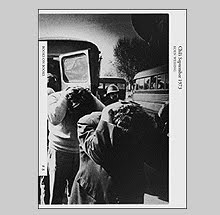
What is interesting is what happens in his photographs as he experiences the different light of each country. The chalky light of Athens renders a much different effect from his images in England. Also, because of flatter topographics, the sweeping vista we are familiar with was apparently not possible in all locations. Thus leaving us at street level and faced with barriers we are used to seeing over.


The catalog of 36 images is nicely produced with an essay by Ian Walker. The constriction of it being a catalog and a small trim size leaves the images less than 6X9 size and too small to really see them properly.

Lili Almog's Perfect Intimacy


For two years, Lili Almog photographer Carmelite nuns living in Israel, Palestine and in Port Tobacco, Maryland. In Perfect Intimacy, through a mix of portraiture and still life, we are allowed a look into a secluded world. We become privy to the lives of the nuns as they go about their daily chores and service of their “love affair” with God.

Although they look like they stepped from central casting for a film of ruler wielding nuns frustrated with youthful impertinence, these aren’t the types. Almog created an accomplished set of formal portraits of several nuns photographed individually against the same wall. In these, we are given a sense of an individual focused on their personal quests. For the rest of the work, Almog serves up well made but obligatory versions of them at prayer and several still lives that are straight from the playbook of any competent documentarian.

Even though we may think we may have already seen images akin to these, what is shown here does contain a strong power of seduction. Seduction is everywhere from the clothing and characters to the quality of light and color palette. Almog's skill and her subjects draw your attention.

The habits (clothing) of the nuns becomes our focal point. The way that cloth falls and folds under its own weight is described in almost fetishistic fashion throughout the book. Grace is felt in these photos partly due to the descriptions of such fabrics.

The natural light is beautiful in these photos. So beautiful that one might be reminded of the light Vermeer was able to describe so deftly.


We also may be seduced in a way that directly correlates to our present age. This is an insular world. A world free from the clutter of ever-present consumerism. Lives are boiled down to the basics and are pleasantly manageable. Our responsibilities have been simplified. Looking at the rooms in which they live, the description of the spaces provide the same gratification one might get from looking at an Ikea catalog or a Container Store flyer. Order reigns.

But with all of this seduction going on, there are occasional instances when the photographs fail at a fundamental level. After enjoying the natural light in one picture, we turn the page to find Almog has lit the next scene with a flash. Albeit this only happens 8 or 9 times in the book and I can imagine out of necessity, her technique is bad and comes across as a flat, vulgar wash. It achieves a consciousness in the viewer that photography is taking place and removes us from the photograph no matter how enticing it may try to be. Another descriptive problem is that her vantage point often exaggerates the distorting qualities of the lens she chose to use. The resulting distortion of walls and furniture is achieves the same effect of distraction.

These criticisms may seem and probably are subjective but for me, they are the failure of the main responsibility a photographer has, which is to tame all of the elements into a complete and irreducible form.

My last piece of criticism is that, although I like this book, what I am not sure of is how much it enlightens us to what life in a monastery is like apart from our preconceived notions. We have here a nice set of pictures but in the end it is more like a confirmation of our mental images rather than a revelation to them.

The book is well designed and printed and was published by Powerhouse Books in 2005. Mark Gisbourne contributes a well written essay that is equally informative of the Carmelite sect and of Lili Almog’s work on this project.

Book Available Here

Laura Letinsky's Now Again


When I mention that I think Laura Letinsky’s table still lives are some of the most exciting photographs made in the past decade, my friends think I’m putting them on. They usually look intensely at my face like they’re waiting for the punchline. Confused, they ask “seriously?”, and screw up their face like they smell something foul. To this I respond “Yes, I'm serious!”, perhaps sounding like an angry dock worker.

I was exposed to Laura’s work through her first book Venus Inferred which is full of well made images of couples. I then saw two shows of her latest still life work in 2002 and 2003 at Edwynn Houk gallery here in New York and was surprised at how much I came away from the show excited by what she was creating. I liked the Venus Inferred images but found their references (beauty of gesture, sexual realism and relationships) tiring as what they describe has been continuously approached by photographers (especially by women artists) of late. So when I saw her departure into completely new territory, I appreciated the risk.

The games Letinsky is playing in this work might be reminiscent of Jan Groover but they do not end with formalism being the dominant force of the work. These photographs teeter between being false constructions (like Groover) and documenting something simply found as is. We may know that we are being manipulated. These objects are painstakingly arranged but their basic make up, stains on tablecloths, spilt grains of food, are so common to anyone that has ever cleared a table that their familiarity exploits our trust.

These photographs, to me, are as much about class and abundance as anything else. There is a sense of money being spent on finer quality food and it being consumed with little regard for waste. The remains have been left behind for someone else, us, to clean up. We are not part of the party. We weren’t invited.

In one image, the discarded pull tab from a can of beer or soda sits below a dividing line of cleanliness and dirtiness. The way the light falls on the table distinctly creates a two tiered sense of what is considered upper crust and what is pedestrian. This is a remarkable descriptive feat considering we have been given: some light, a tabletop adorned with glass stains, a piece of metal and some pieces of fruit.

One other remarkable feat is that we are presented with many of these photographs that often work in similar ways and yet I do not tire of them. That isn’t to say that all are necessary but I would argue that a strong majority of them should be seen. Letinsky seduces us in each frame with new forms and delivers descriptions of light that would entice anyone with the gift of sight.

Now Again published by Galerie Kusseneers in 2005 gathers together 33 of the table still lives along with 18 newer works in a nice small catalog. It is well printed and cleanly designed but it reads as what it is, a catalog. I would have preferred the newer works in the later part of the book have been left out to make a more complete package. There is another title published by the Renaissance Society called Hardly More Than Ever which I do not have but from what I remember from leafing through it once, it is entirely of the table still lives.

The newer photographs are interiors of houses that are either being moved into or out of.


Let’s hope that they have solid foundations and great light.

Book Available Here

Monday, May 7, 2007

Gertrude Blom and Jonathan Moller


Gertrude Duby Blom first arrived in Chiapas, Mexico in 1940 as a political refugee escaping the war in Europe. Her prior activities as a political activist had landed her in jail in Mussolini’s Italy and in a Nazi prison camp in France at the beginning of the war. Upon her arrival in Chiapas, she was introduced to Ladino and Mayan communities of whom she would spend the rest of her life befriending and documenting.

There have been many books of her work published. Two of note are, Gertrude Blom: Bearing Witness published in 1984 by the University of North Carolina Press and the other is Chiapas Indigena published in 1961 by the Universidad Nacional Autonoma de Mexico.

In his introduction in Bearing Witness, Alex Harris wrote of Blom: “It is particularly in her photographs of the Lacandones and their jungle environment that Gertude Blom joins the ranks of other great social observers with a camera, like Laura Gilpin, Dorthea Lange, and Eugene Smith, photographers who earned the trust of their subjects, in part, because they cared a great deal for the lives and fates of the people they portrayed.”

Blom didn’t consider herself a photographer. She was an amalgam of part journalist, social activist, explorer, ecologist and anthropologist. The photographs exist as a way of holding onto a primitive culture that was butting up against the advancement of the twentieth century. Working mostly with a 6X6 medium format camera, Blom shows us their daily life and cultural traditions in an intimate way that radiates warmth towards her subjects. She also fought tirelessly to stop the destruction of the surrounding rain forests and her images of the jungle are often the more complexly constructed of all of the work.

For someone who didn’t consider herself a photographer, she produced a lot of photographs that I would argue hold their own next to the likes of Pierre Verger or Martin Chambi. Bearing Witness gives us 104 photographs alongside three essays about Blom and this disappearing community.

The book itself is interesting for the photographs and the anthropological study of the subjects. Its design is decent but the reproductions are surprisingly mediocre considering it was printed by Meridian Gravure Company. I also have seen the paperback edition of this same title and the reproductions were even worse. Beware of this should you want a copy.


The other title, Chaipas Indigena is authored by Gerturde Duby, apparently she took her husband Frans Blom’s name only some of the time (keep this in mind when searching for books). This book was produced in Mexico so all of the text is in Spanish. Again, it is a kind of anthropological study that happens to be illustrated with good photography.

This title is, by most photobook standards, poorly printed but it has a certain charm to the whole production. It has 138 black and white photographs and a few in full color that are saturated to the point of being surreal. The photographs are laid out on the page in a playful manner and many are cropped into various ratios. This seems like more of an element of the book’s design than her usual practice. Although there are a few cropped images in Bearing Witness, there are very few in this book that follow the ratio of her square format camera.

The subject matter is like in Bearing Witness, the indigenous communities around San Cristobal de Las Casas in Chiapas. I find it amazing that she was accepted into these communities with such strong trust. It is even hard for Mexicans to access these communities let alone someone originally from Switzerland.


Another title by a different author, Jonathon Moller’s Our Culture Is Our Resistance: Repression, Refuge, and Healing in Guatemala, shares a similar sense of study and activism for Latin American communities in turmoil.

For ten years, Moller, a human rights activist and photographer, documented communities in Guatemala that have been displaced by war. Like Blom, Moller is fully accepted into the communities he is documenting. Using 147 photographs alongside quotes from his subjects, this book serves as a document of historical record and as a monument to the deceased.

It is dense book full of content that covers many bases. On one level, it can be viewed as a history lesson. On another, it can be seen like Blom's as anthropological. Or it seems it could be used to create a legal case to seek justice for the victims. (All of the author’s royalties were donated to the Association for Justice and Reconciliation in Guatemala)

The book is well designed and decently printed and was published in 2004 by Powerhouse Books.

Book Available Here

Yale University Art Gallery Bulletin 2006


When I mentioned in my Tony Ray-Jones post that he attended Yale School of Art it reminded me of the current Yale Art Gallery Bulletin for 2006 as it is dedicated to photography. It is paperback, 230 pages and very nicely produced. From what I heard, the production was subsidized and the retail price of twenty dollars doesn’t even come close to covering what it cost to produce.

It is a very informative read with many articles on both photography and photographic education. There is one by Robert Adams who chose four landscape pictures from four different photographers and wrote short pieces about each. Tod Papageorge wrote a tribute to Richard Benson who has been the dean of the school for the past decade. There is a piece on Aaron Siskind and action painting. Joshua Chuang produced a fine essay called, When the Messenger Is the Medium: The Making of Walker Evans’s American Photographs and Robert Frank’s The Americans. Charlotte Cotton evaluates Yale and contemporary photography and Rebecca Soderholm contributes an essay called, The Mystery of Photographic Longevity or Keeping It Out of Dean Benson’s Trash Can, as well as many others.


It is profusely illustrated and features some of the work of recent Yale graduates alongside other works by the masters mentioned. It’s far from a complete education in itself, but then again, it didn't cost you seventy thousand dollars.

Images above are three alternate covers by Alfred Leslie for the Grove edition of Robert Frank's The Americans.

Friday, May 4, 2007

Tony Ray-Jones published by Chris Boot


“I have tried to show the sadness and humour in a gentle madness that prevails in people. The situations are sometimes ambiguous and unreal, and the juxtapositions of elements seemingly unrelated, and yet the people are real. This, I hope, helps to create a feeling of fantasy. Photography can be a mirror and reflect life as it is, but I also think that perhaps it is possible to walk, like Alice, through the looking-glass, and find another kind of world with the camera.”

With these words printed directly onto the cover of the book Tony Ray- Jones published by Boot in 2004, we finally get an extensive view into Jones’ world. Although there have been other titles of his work published this is by far the most handsome and informative yet. The design by Stuart Smith brings a fun contemporary feel to the whole package.

Dead from leukaemia by the time he was only thirty, he left an enduring mark on photography especially in England. The strength of the work was made accessible to other generations of photographers through the posthumously printed book A Day Off. The 120 photographs in A Day Off were made entirely in three years. 1967, 1968 and 1969 were very prolific years for this young artist. The photographs describe in documentary style, the English at the seaside, at summer carnivals, dancing and in the streets of London. Their most identifiable strength is Tony Ray-Jones’ signature flair for creating a complex order to the chaos of everyday British life.

After the introduction to the book, we are given a timeline of his life with important dates notated that make for an interesting read. He studied Graphic Design at Yale University’s School of Art with Paul Rand and Josef Albers, made two unsuccessful runs at becoming a member of Magnum Photos, once interviewed Brassai for Creative Camera magazine and befriended Alexey Brodovitch. At the end of the book there is an interview between Bill Jay who was the founder of Creative Camera and photographer Martin Parr discussing Tony and his lifework. Bill Jay relays a funny anecdote about first meeting Ray-Jones in the offices of Creative Camera magazine, Ray-Jones said “Your magazine’s shit, but I can see you’re trying. You just don’t know enough, so I am here to help you.”

Tony Ray-Jones’ entire career in photography is summed up in twelve years of work with three white hot ones when he was at the top of his game. Ray-Jones would be only 66 today if he hadn’t been cut down at such a young age. One can only wonder what we would be looking at had he been given the chance at thirty more years.

That is our loss, but this book holds tightly what he created until the end.


In 1990 Cornerhouse Publications released an edition of Tony Ray-Jones’ work on what would have been his fiftieth year had he lived. This is a decent book of his work, although it really suffers when compared to the Boot title. This title includes a few photographs of Ray-Jones’ years in the United States which is interesting to see and compare to his work done at home. It makes the mistake of including eight color photographs that mostly seem to have fallen out of his editorial portfolio and this brief encounter with color doesn't make sense, is distracting, and lowers the tone of the book. It houses 70 images and includes a few from very early on in his career.


A Day Off is also good in its offering up most of his best images but is flawed as a showcase for his work. The problem for me is that the photographs are grouped into subjects with chapters named “The seaside” and “Society” and “London.” The book then tends to read as simply literal groupings of separate images and the reader isn’t taken anywhere between the photographs.

Luckily we now have a better home for them as the photographs are too complex in their construction and commentary to have been so short changed for all these years.


Book Available Here


Joan Colom and Brassai


Joan Colom and Brassai (Gyula Halasz) have a lot in common. Both started photography after the age of 30. They were fascinated with street life both in the day and at night. Both chose specific areas in which to work. Brassai’s was the 13th arrondissement in Paris. Colom’s the neighborhood of El Raval in Barcelona. Both photographed people in those areas who would be considered marginal. Lastly, both often cropped their images to find more perfect forms.

The Fundacio Foto Colectaniain in Barcelona published a book called Brassai - Paris Colom - Barcelona: Resonancias which compares these two artists and their working methods. The first half is dedicated to Brassai and the second to Colom.

The work of Brassai is, of course, the more well known of the two. The books Paris By Night and The Secret Paris of the 30’s have seen many editions and printings since their first appearance. Brassai had written of this time in his life,


“During my first years in Paris, beginning in 1924, I lived at night…we reveled in the “beauty of sinister things.” Sometimes impelled by an inexplicable desire, I would even enter some dilapidated house, climb to the top of its dark staircase, knock on a door and startle strangers awake, just to find out what unsuspected face Paris might show me from their windows.”

Much of Brassai and his work is common knowledge but what is interesting about Resonancias is that we are shown several of Brassai’s photos as they were exposed on film in full uncropped versions and overlaying the photograph are crop lines specifying how he manipulated the final image.

The book poses that since Brassai was a writer as well as photographer, he was more accepting of his art’s need for revising after the first attempt. Brassai was using the equivalent of a medium format camera mounted on a tripod. The slow film available also meant a need to provide the light (magnesium powder) in order to make proper exposures and freeze his moving subjects. Using these tools, the edges of his photographs were bound to be imprecise and require alterations. Much in the way a writer toils over word choice and grammar in order to create a finer sentence.

Joan Colom, on the other hand, was using a small, unobtrusive 35mm camera to describe what he was witnessing in the streets of El Raval in Barcelona. His need for altering his photographs arose from the fact that often he shot without looking through the viewfinder. Unlike Brassai who was working most often with the cooperation of those he was photographing, Colom wished to go unnoticed, searching for “images that touch me” and remain authentic.

Because of Colom’s way of shooting, his revisions of the images often wind up with varied frame ratios. Some stay close to the 1:1.5 ratio of 35mm and others are wildly cropped into a vertical panoramic shape that narrow our view and focus our attention.

El Raval, was the red light district of Barcelona where he photographed between 1958 to 1961. Colom’s camera weaves through the crowd grabbing at gesture, expression and body language and often narrowing down the information with a sketch-like directness. Whether he is photographing negotiations for sex or picking out faces in the street life, he does so without judgement. He achieves in his description a tone of the barrio that gives a sense of comradeship among its patrons.


A different book published by Steidl last year called Joan Colom: Raval (French edition is Joan Colom: Les Gens Du Raval) gives us a look at 83 photographs from this body of work. The book is well designed and printed using scans from Colom’s prints instead of negatives. In the reproductions we often see the large grain of the images fall in and out of focus from imprecise enlargements (perhaps something only printers are sensitive to).

When some of this work was published in 1964 as Izas, Rabizas y Colipoterras with writing by Camilio Jose Cela it was met with disapproval from the Franco regime because of the frankness of its subject matter. Partly due to this controversy, Colom put down his camera for twenty years and didn’t return to photography until the 1980’s.

When one thinks of these two artists, Brassai and Colom, it is common to overlook the surrounding cultural environment in which they were working. For Brassai, it was the burgeoning intellectualism of Paris in the 1930’s where he was surrounded by the likes of Henry Miller, Picasso, Mattisse, Giacometti and Jaques Prevert.

For Colom however, it was a Spain repressed and culturally dulled by Francisco Franco.

Book Available Here

Book Available Here (Paperback Edition)


Harlemville by Clare Richardson


Harlemville by Clare Richardson is an elegant little book.

For three years starting in 2000, Richardson photographed in Harlemville which is a Rudolph Steiner community. Rudolph Steiner was a philosopher, educator and social thinker who developed a schooling system based on his idea of “Anthroposophy.”

“Anthroposophy is a path of knowledge, to guide the spiritual in the human being to the spiritual in the universe…. Anthroposophists are those who experience, as an essential need of life, certain questions on the nature of the human being and the universe, just as one experiences hunger and thirst.” (thanks to Wikipedia)

These are photographs are mostly of children in what may be perceived as a summer camp setting. They swim, roll in mud and explore river beds absorbed in their duties and generally show no interest or awareness of Richardson’s camera. Richardson gives us a lush description from what I believe is a medium format camera (otherwise it’s 4X5) and the color palette is rich yet subtle and obviously full of earth tones. The photographs for the most part are very well made.

The book itself is the perfect trim size for this work and the printing is very good. It is designed as a one picture at a time on the right hand page, no captions or page numbers. The photos have a nice sized border that defines their edges nicely. There is no superfluous text, we get right into the photographs after the title page and at the end we are provided with a very small statement by Clare Richardson about Harlemville, the place. It was published by SteidlMack in 2003.

For me, the book seems split into two sections (although I do not think this is intentional). First we follow a group of boys for about 25 images and then the last 12 are mostly of young girls but the girls do not engage in nature with the same intensity as the boys. It is also in this last “section” that a couple of adults appear in the photographs.

Because of the lack of adults, the first part of the book seems to allude strongly to William Golding’s Lord of the Flies. A group of boys, out in nature, without parental guidance. They hang around and pass time swimming. Then they equip themselves with spears. Conflicts seem to arise. Individuals are cast out of the group. Some images hint at a pursuit for survival. Pain is alluded to and in the end, they go seriously native covered in mud camouflage. I like the way the sequence leads us in that direction. I don’t know that literary reference was intentional.

My problem was that since that reference fit so well, when I got to the last 12 images of mostly girls, it was a jarring departure from the direction the sequence was building. I also just think that several of the last 12 images should have been left out of the edit. Especially the few photographs that include the adults. Even though the book only has 37 photographs, 32 would have made a stronger book in my opinion.

What Richardson perhaps had a hard time with when editing is that you often have to leave your weakest children behind. That is simply another example of survival of the fittest.

Book Available Here

Book Available Here (Beyond The Forest)

Thursday, May 3, 2007

W. Eugene Smith and Charles Pratt in the city


In 1955, W. Eugene Smith was commissioned to produce an essay on Pittsburg that was to be included in a book by Stefan Lorant commemorating the city’s bicentennial. The commission was to last three weeks and hopefully produce one hundred photographs. Smith wound up photographing for a year (most of 1955 and on two return trips in 56 and 57) and produced nearly seventeen thousand images, 200 of which he would later remark was his “greatest set” of photographs. Most of the images have never been seen and until his death, Smith kept the prospect of publishing the work in book form on his list of future projects.

About a year before Smith was to undertake his project, a former stage manager on Broadway turned photographer named Charles Pratt started a similiar ambitious project in New York. Without commission, Pratt set out to describe the edges of the city and for fifteen years would do so until a few years before his death. This unfinished body of work, like Smith’s, would not see its way into book form until well after the photographer’s death.

Although both projects started at the sound of different guns, they are similar in their approach to their subjects. Both seem to attempt an all encompassing view of their subjects with little regard for parameters. Smith started with a commission for 100 photographs and to attempt “the greatest of the impossible,” to create an epic portrait of the city and its populace at the peak of its industrial importance.

Pratt’s approach, with the added benefit of having no deadline, was equally open to tangents and as such, he explored and responded accordingly. Unlike Smith though, he was working in an area that was perceived to be disappearing. In an essay called The Edge of a City, Pratt writes:

“This is an attempt to characterize a place that is fast vanishing - the edge of the city. It is vanishing because American cities are growing out toward each other, their suburbs blending into one big suburb. It is predicted that New York, where I live, will someday be just one part of a long strip of megalopolis extending from Boston to Washington; in this urban-suburban complex there will be no outskirts…So I find myself drawn to edges with a sense of urgency, knowing that they may be gone tomorrow- not just extended but really, finally gone.”

Both photographers work describing two different aspects of city life that share common denominators. In both essays we observe people at work, rest and play and there is a similar tone to the images. From both bodies of work there is a celebration of life and certain air of heroism when we are shown images of workers. Both photographers achieve a quiet harmony in their images that is vastly different from another photographer making his way around the country, Robert Frank.

In 2001, 46 years after the original project was completed, W.W. Norton published the book Dream Street: W. Eugene Smith’s Pittsburg Project. This book, which holds over 160 photographs, is not an attempt to re-create the essay Smith may have had in mind for publication. In 1959, Photography Annual published an 88 images essay called “Labyrinthian Walk” and this best represents an edit and sequencing that came directly from Smith. Smith did state that there were 200 images that represented “a synthesis of the whole” but failed to identify which images he was referring to. This book is an interpretation of that reference.

For work that is not only legendary to the photographer’s biography but of importance to his archive, this book does little to honor the work. The design and poor reproductions drain the life out of this body of work, leaving us with a boring, lackluster presentation. For all of the editor’s ravings of the beauty of Smith’s prints, they lay on the page in dusty duotone that lacks any richness and are arranged on the page in a jumble. (What ever you do, do not slip off the dust jacket to reveal the cheapness of the library style cover materials as it is depressing.)

I fail to understand why publishers will lay their hands on gold and then present tin. I know the common answer to this would be the bottom line dictates, but publishing a book today is relatively inexpensive. For an extra few thousand dollars one could make the book read and feel better in the hands of the buyers and present the work in the manner in which it deserves. This is a way of seducing and in turn, separating people from their money. I have many books that I have been pushed over the edge to buy because of the way they feel. I cannot imagine that with a project this interesting there couldn’t have been a way of finding the little extra cash that would have made the book’s production better.


The other answer might be that the publisher thinks the book has been well done. I can’t imagine, but in matters of taste all is possible.

Book Available Here


In 1998, Nazraeli Press published The Edge Of The City: Words and Photographs by Charles Pratt, New York 1954-1969. This book, unlike the disaster with the Smith book, does honor the work in a handsome and well produced edition. The photographer John Gossage was in on the design for this title and we should be happy for that. Gossage, who designs his own books, has excellent instinct for page layouts and sequencing. Working with another designer Gabriele Franziska Gotz, they don’t pollute the page with images. They allow the work its space to be enjoyed unobstructed. The images are also better printed in duotone than the Smith book. I wouldn’t say that the reproductions are great or even fine but the images read at least as healthy and not on their deathbed.

These two books sit nicely next to one another and can be compared and contrasted. Smith, the more famous of the two, shows us a of city through obsessive work habits and a sense of being everywhere at once. While Pratt engages us with a calm, peaceful stroll through a changing landscape.

Book Available Here

Carnet De Voyages by Le Point Du Jour Editeur


In the late nineties, the French publisher Le Point Du Jour Editeur released a series of photo booklets of various photographers paired with a writer. Each booklet averages ten pages and only holds about ten pictures and cost about ten dollars each. The series was called Carnet de Voyages and I think there were twelve different books published in this series.

What is nice about these booklets is the design. They are printed on long sheet of paper about 36 inches long and then accordion folded into the shape of a book. The trim size is 5 inches by 7 inches and most all of the series holds to that dimension. The photos take up the top half the space on a page and the text is below.

Most of these small booklets were dedicated to the work of relatively little known photographers. Out of the twelve, I only knew two of the names. De Mala Muerte by Antoine d’Agata and L’Au-Dela Est La by Paolo Pellegrin. Other photographers in the series are: Jerome Schlomoff, Christophe Bourguedieu, Dieder Ben Loulou, Denis Roche, Jean-Christian Bourcart, Raymond Marcherel, Djan Seylan, Dolores Marat, Laurie Vasconi and Christopher Taylor.

De Mala Muerte by Antoine d’Agata (1998 Carnet de Voyages Numero 5) takes us on a small journey into a bar in Tijuana Mexico where we drink with the locals and then spend the rest of the night in a hotel room with a prostitute. For those of you that are aware of Agata’s work, this has the same dark, dreary world of beaten spirits and exhausted lives feeding on intoxication and sex in pursuit of escape. The subjects seem slapped down for simply asking to be loved.


Shot in 35mm the photographs have the same gritty sensibility as the surroundings they describe. Agata’s camera often has a physical quality to the images, embracing blur and motion that adds to our sense of intoxication. The text by Paco Ignacio Taibo II feeds us the verbal equivalent of the photographs. These images would also be included in Agata’s book Mala Noche (1998 En Vues).


L’Au-Dela Est La by Paolo Pellegrin (2000 Carnet de Voyages Numero 10) is made up of images from Bosnia and give a child’s view of conflict and the physical and psychological damage that occurs. Using a square format camera Pellegrin describes the landscape and children not a photojournalistic way, but more akin to how Ralph Eugene Meatyard might have approached the subject. The photographs are poetic in their form and content yet still vent the concerns of a 1996 Bosnian world.

I find this work much more compelling than his more recent work. He achieves a quick portrait of the inner and external lives of children forced to grow up quicker than they should have to. The only evidence of adults here is the violence seen in the landscape. The text is by Regis Jauffret.

Wednesday, May 2, 2007

Bertien Van Manen's Give Me Your Image


For three years while traveling in Europe, Bertien Van Manen took photographs of photographs. The resulting work has been published in a small book by Steidl called Give Me Your Image.

What I mean by photographs of photographs is that she made small still-life style images of family photos as they are commonly displayed in households. Using color film and apparent on-camera flash, she describes the photographs and the objects surrounding them. The photographs she photographed range from the very old to the very recent.

The form of the photographs (Van Manen’s) doesn’t vary greatly throughout all of the work. For the most part, the photo that is photographed winds up in or very near the center of the picture and the remaining details of furniture or other décor fills and falls out of the rest of the frame.

I was initially seduced by this work but after repeated viewings I’ve started to find it lacking for a few reasons. First and the most obvious is that, in most of these photographs, it is the photo in the picture that is most interesting. Van Manen often fails to make a more interesting image out of what she is looking at. I may have mentioned this before but a photograph must be more interesting than what was photographed. If that element (the photograph) is removed from these images then we aren’t left with much. It is not the form of these photographs that will carry the weight when the object isn’t interesting to us anymore.

The objects themselves are interesting though. Several are old black and white images of soldiers or loved ones from different eras. Photographs like these are inherently interesting to look upon as they transport us into the past and inform us as to what things looked like. They are windows to history. I believe they are interesting to us by default. She also utilizes another tool of seduction, the use of color. Red curtains or walls that are entirely green have a tone and richness that excite the eye.

She frames the objects directly but with the camera often tilted in ways that, if one were to read into it, mimic natural abstracted human sight. If it weren’t for the artificial sense of light from the flash, these images may mirror what a person would see looking over someone’s belongings on a bookshelf. The flash negates this sense and we are just aware of the photographer’s self conscious direction of attention.

What is interesting is where the photographs in these pictures are displayed and what that implies to the viewer. Some photos are placed among other objects on a shelf and thus have the sense of a constant but perhaps often neglected companion. Others are placed in such odd places simply because that is where they can be easily and most often accessed by sight. Those images take on an immediacy that others do not. This is an interesting fact at play in some of these photographs. The problem is that we have 68 of them where the 20 most interesting and formally accomplished photographs would suffice.

The book itself has a nice trim size and is well printed but the design is problematic. The images are bled to the page edge and all that are horizontal run across the gutter. As I mentioned before, the images she is photographing fall often directly in the center of the frame so we are robbed of a clear and unobstructed view of them. There are many verticals in the book that are pared with a second vertical on the facing page that resemble one another in terms of color palette. It creates the sense of them all being of horizontal. The funny thing is that once you realize this, you also realize that the individual page ratio is not the same as the ratio for a vertical 35mm image. So 15% to 20% of each of those images has been cropped off in the design. I guess one could say that it is a blessing that these are center heavy images with little of importance near the edges.

These documents of personal histories are important. We use photography to hold onto images of loved ones. And these photos often make up the abbreviated histories of those individuals since often there is no written record. Abbreviated in that they show how the people looked on birthdays, first communions, weddings or any other “important” day when the camera is brought out. This is one aspect of why this work by Bertien Van Manen exists. Memory is a strong aspect of our lives. Our family albums are full of important and fascinating history.

Though, in my opinion, that is where the “real” art is held, in those albums. I just don’t think that Bertien has added much to that fact.

Book Available Here

Daido Moriyama's Farewell Photography


I have never seen a copy of Daido Moriyama’s Sashin yo Sayonara (Bye Bye Photography) in person to say how it compares to the new edition published by Powershovel Books called Farewell Photography.

What I have been told is that it is a reprint that used a copy of the original as source material since none of the original prints or negatives still exist (the “real” Bye Bye Photography, as throwing out negatives is the antithesis of photography in the first place). It is larger in trim size than the original and I will venture to guess that the paper and in turn, the printing, is much different. I think the original was printed in gravure on a matte paper. This printing is on thick glossy magazine stock. The original included a text which was a conversation between Moriyama and Takuma Nakahira which is absent in this edition. In essence, with the change of title and appearance, this represents an interpretation of the original.

In these books, Moriyama is casting aside all conventions of photography and in turn, I believe, attempting to turn the viewer off to photography as well. Rarely in this book can the viewer tell what it is that we (or the photographer) are looking at. We are “shown” images in a barrage fashion and then we ask what is their relevance and association to one another. Confusion is inevitable if trying to read the book using logical approach. This book acts as a collection of images or memories that the mind would usually discard to make room for images “worth” remembering. These are non-moments and non-subjects described in a non-fashion. Moriyama seems to be attempting to erase all reference to specifics and thus cast out the baggage of direct meaning that may come with clear description.

In addition, the surface of these images is bombarded with scratches, light leaks and dust. There is constant reference, in these imperfections, to the physicality of photographic materials. Moriyama is repulsing the viewer in everyway possible to photography (possibly only a book of blank pages would accomplish a similiar dismissal of photography) while still using the materials. This reprint may achieve that better than the original.

This second generation, copy of a copy, probably obscures more detail and diminishes further the short tonal range of the original. Not to mention that the gravure of the original would seduce the reader in ways that this edition’s printing won’t. The surface of these pages is so glossy that room light reflected off its surface adds another barrier to the images. I won’t even mention the gutter of the book.

Of the original he declared, “I wanted to go to the end of photography.” It is curious that he went to the “end” and then in his later work returned to a safer place.

Perhaps this wasn’t the end he wished to find.